
Yes. If you hold a current or recently active clearance, list it, and put it on a single line directly under your name and contact information. That line should name the level (Secret, Top Secret, TS/SCI, DOE Q or L), the status (Active, Current, or Eligible), and the polygraph type and date if one applies. That one line does more for your callback rate than almost anything else on the page.
TL;DR:
- Listing your clearance in the header line improves ATS detection and grabs a recruiter's attention, especially when paired with mentions in recent job entries.
- Use precise, industry-standard phrases like "Active TS/SCI with CI Polygraph"; avoid vague language that decreases searchability.
- Only publicly share unclassified facts such as clearance level, status, polygraph date, and investigation type; keep sensitive program and mission details off your resume.
- Clarify clearance statuses by including adjudication dates, with "Active" indicating current use and "Eligible" meaning reinstatement is possible within a certain window.
- Tailoring multiple resume versions for cleared and non-cleared roles increases callback chances, especially when the clearance is not relevant to certain commercial job applications.
Table of Contents
- Where to Put Your Security Clearance on a Resume
- What Exact Wording Should You Use for Each Clearance Level?
- What Can You Safely List Without Violating OPSEC?
- Active, Current, Eligible, or Lapsed: What Do These Statuses Actually Mean?
- How Should You List Your Polygraph on a Resume?
- How Do You Describe Classified Work Without Disclosing It?
- How Do ATS Systems and Recruiters Actually Scan for Clearance?
- How Long Should a Cleared Resume Be, and Does Format Change by Employer Type?
- Fillable Header and Summary Templates You Can Use Today
- Behind This Guidance: Pluck Talent's Recruiting Background
- When Should Your Clearance Lead the Resume, and When Should It Step Back?
- Get Your Cleared Resume in Front of the Right Hiring Managers
- Where This Guidance Comes From
- Sources
- FAQ
Where to Put Your Security Clearance on a Resume
The header is the highest-leverage spot. A line directly under your name and contact block catches a cleared recruiter's eye before they read a single bullet, and it's the first field an applicant tracking system tries to populate when it scans for clearance data. If a system like Workday or iCIMS can't find that field near the top, it sometimes misses it entirely, especially on resumes with dense two-column layouts.
That doesn't mean the header is the only place it belongs. Depending on your background, you have four realistic placement options:
- Header line: fastest path to both ATS fields and a human recruiter's eye; use this on every cleared-role application.
- Summary paragraph: works when you need a sentence of context, such as explaining a clearance sponsored by a former employer versus your current one.
- Dedicated Clearances section: worth building if you hold more than one clearance, or if you're carrying a DOE Q or L designation alongside a DoD clearance.
- Per-job notes: repeating the clearance level inside relevant job entries shows it wasn't just granted once and left dormant.
That last point matters more than people think. A clearance mentioned only once, buried in a job from 2019, reads as historical rather than current. Repeating it in your most recent one or two roles tells the recruiter you're actively using it, not just holding a credential you earned years ago. Combining the header line with at least one per-job mention is the pattern that performs best across both ATS parsing and human review.
What Exact Wording Should You Use for Each Clearance Level?
Vague language costs you visibility. Recruiters and ATS filters search for industry-standard phrases and abbreviations, not creative paraphrasing. "Cleared for sensitive government work" will not surface in a keyword search the way "Active TS/SCI" will.
Use this pattern: [Clearance level] + [Status] + [Polygraph, if any] + [Agency, if useful] + [Adjudication or grant date]. Here's how that breaks down by level and status.
| Clearance level | Copy-ready header line |
|---|---|
| Confidential | Active Confidential Clearance (DoD, adjudicated 2023) |
| Secret | Active Secret Clearance (DoD, adjudicated 2024) |
| Top Secret | Current Top Secret Clearance (DoD, adjudicated 2022) |
| TS/SCI | Active TS/SCI with CI Polygraph (DoD, adjudicated 2024) |
| DOE Q Access | Active DOE Q Clearance (adjudicated 2023) |
| DOE L Access | Current DOE L Clearance (adjudicated 2021) |
A few phrasing notes worth internalizing:
- Spell out the agency shorthand once (DoD, DOE, IC) if the role or job posting expects it, especially for IC-adjacent positions.
- Include the adjudication date whenever you have it. It tells a recruiter whether your background investigation might still be reusable for a new sponsor, which speeds up onboarding decisions on their end.
- Never translate an old investigation type into a modern tier number. If your official record says "SSBI adjudicated March 2022," write exactly that. Recruiters cross-check phrasing against DISS and Scattered Castles records, and a mismatched conversion raises questions you don't want raised before an interview.
What Can You Safely List Without Violating OPSEC?
Clearance level, status, investigation type, and polygraph date are all unclassified facts. Federal guidance is explicit on this point: the NSA's public resume guidance confirms you can list your clearance and polygraph dates, while warning against anything that reads like an intelligence report meant for internal circulation rather than a public job board.
What crosses the line is specificity about the work itself, not the credential. Keep these off a public resume:
- Classified program names or compartment names, even ones you assume are widely known in your industry.
- Specific classified system identifiers, code names, or internal project designations.
- Sensitive locations, deployed unit specifics, or anything that maps your work to a particular facility or mission set.
- Client or contract names if your NDA or facility security officer has flagged them as restricted.
Pro Tip: If you're not sure whether a detail is safe to disclose, don't guess. Ask your facility security officer or security manager directly, or default to a more generic functional description. "Supported enterprise network defense operations" survives review every time; a specific program acronym might not.
Recruiters in this space aren't afraid of clearance disclosure itself. The risk they're actually watching for is candidates who overshare mission details trying to sound impressive. Stick to unclassified facts about the credential and you're fine.
Active, Current, Eligible, or Lapsed: What Do These Statuses Actually Mean?
These four words carry different operational weight, and using the wrong one can either undersell you or set expectations you can't meet.
- Active means your clearance is currently sponsored and you're using it right now in your present role.
- Current typically means you held and used the clearance within the last 24 months, even if it's not actively sponsored today.
- Eligible means you're outside active use but still within the window where reinstatement is realistic without a full new investigation.
- Previously held applies once more than 24 months have elapsed since your last use, meaning reactivation likely requires a fresh review.
Sample phrasing for each: "Active TS/SCI (DoD, adjudicated 2024)" for someone using it today. "Current Secret Clearance, last used 2025" for someone between contracts. "Eligible for Secret reinstatement, adjudicated 2023" for a lapse still inside the reinstatement window. Include the adjudication or last-use date whenever you can. A dated line is more actionable to a recruiter than a bare status word, because it tells them exactly how much runway they have to work with.
How Should You List Your Polygraph on a Resume?
Listing "polygraph" alone tells a recruiter almost nothing useful. Polygraph requirements vary by agency under ICD 704, so a CI-scope polygraph and a Full-Scope polygraph are not interchangeable, and a recruiter staffing an IC role needs to know which one you hold before they can act on your application.
Name the type and the month and year it was completed:
- CI-scope: "with CI Polygraph (completed June 2024)"
- Full-Scope: "with Full-Scope Polygraph (completed March 2023)"
- Lifestyle: "with Lifestyle Polygraph (completed January 2022)"
Paste that directly after your clearance line: "Active TS/SCI with Full-Scope Polygraph (completed March 2023)." That single addition can eliminate an entire round of screening questions, because it confirms upfront that a requirement many contractor and IC roles treat as a hard gate is already satisfied.
How Do You Describe Classified Work Without Disclosing It?
The formula that works: function + scale + measurable impact, with unclassified tool names where it's safe to use them and generic functional descriptions where it isn't.
- Lead with your role and team size, not the mission. "Led a 6-person watch team supporting enterprise network defense operations across a 15,000-endpoint environment" tells a hiring manager exactly what you're capable of managing without naming a single classified system.
- Quantify outcomes wherever you can. "Reduced incident time-to-contain by 40% through updated triage procedures" is specific and defensible. It's a process metric, not a classified detail, and it's the kind of line a resume screener remembers.
- Name tools generically when the specific product is sensitive. Write "enterprise SIEM platform" instead of naming a restricted internal tool, or use the actual product name when it's a commercial, unclassified tool like Splunk or CrowdStrike that's safe to disclose.
A few sample bullets built on that pattern:
- "Administered enterprise SIEM platform supporting 24/7 SOC operations across a multi-site network, cutting mean detection time by roughly a third."
- "Coordinated with cross-functional intelligence teams to deliver weekly threat assessments briefed to senior leadership."
- "Managed vulnerability remediation across 200+ networked systems, maintaining compliance with DoD RMF and NIST 800-53 controls."
Pro Tip: Read every bullet back and ask whether a stranger with no clearance could learn anything sensitive from it. If the answer is no, and the bullet still communicates scale and outcome, it's doing its job.
How Do ATS Systems and Recruiters Actually Scan for Clearance?
Applicant tracking systems like Workday, Taleo, and iCIMS try to autopopulate a dedicated "Security Clearance" field the moment they parse your resume, and they pull most reliably from text near the top of the document. Bury the clearance in a job description from three roles back, and the system may never catch it.
Use exact, industry-standard phrases. "Active Top Secret/SCI" is what recruiters and filters search for; write out "Top Secret/SCI" in full at least once, even if you also use the abbreviated form elsewhere on the page.
Formatting rules that protect your parsing accuracy:
- Keep the clearance line in plain text, not inside a text box, header/footer element, or embedded image, since most ATS parsers skip those entirely.
- Avoid unusual characters, icons, or decorative dividers around the clearance line.
- Place it as its own line item, not buried mid-sentence inside a paragraph.
How Long Should a Cleared Resume Be, and Does Format Change by Employer Type?
One page works for early-career cleared candidates with limited experience. Two pages is standard and expected for mid-career or senior cleared IT and cybersecurity professionals, and going shorter than that can actually undersell relevant experience.
- Federal applications through USAJOBS often require more narrative detail than a private-sector resume, including specific duties and hours per week, so don't reuse your contractor resume there without adjusting it.
- Contractor and IC-focused resumes should stay tight, unclassified, and scannable, prioritizing clarity over exhaustive detail.
- Keep clearance metadata (level, status, polygraph, date) to one or two lines total. It should never eat space that belongs to your actual accomplishments.
Fillable Header and Summary Templates You Can Use Today
Different hiring paths expect slightly different framing. Here are three starting points.
Contractor-focused:
Active TS/SCI with CI Polygraph (DoD, adjudicated 2024)
Cybersecurity engineer with 6 years supporting DoD enterprise network defense and incident response.
IC-focused:
Active TS/SCI with Full-Scope Polygraph (completed 2023)
Intelligence operations specialist experienced in cross-agency threat analysis and reporting.
Federal civilian:
Current Secret Clearance, last used 2025
IT specialist with federal systems administration background supporting mission-critical infrastructure.
For a lapsed clearance, try: "Previously held Top Secret Clearance, adjudicated 2021, eligible for reinstatement." It signals you're not starting from zero if a new sponsor wants to bring you back in.
Behind This Guidance: Pluck Talent's Recruiting Background
Recruiting specialists have spent many years placing IT and cybersecurity professionals into cleared and uncleared roles, working directly with hiring managers rather than relying solely on job board postings. That recruiting background, paired with Plucky AI's resume optimization tools, shapes the phrasing recommendations throughout this guide. This piece draws on patterns recruiters at Pluck Talent see succeed and fail across hundreds of cleared-candidate submissions, not generic resume theory.
— Diego
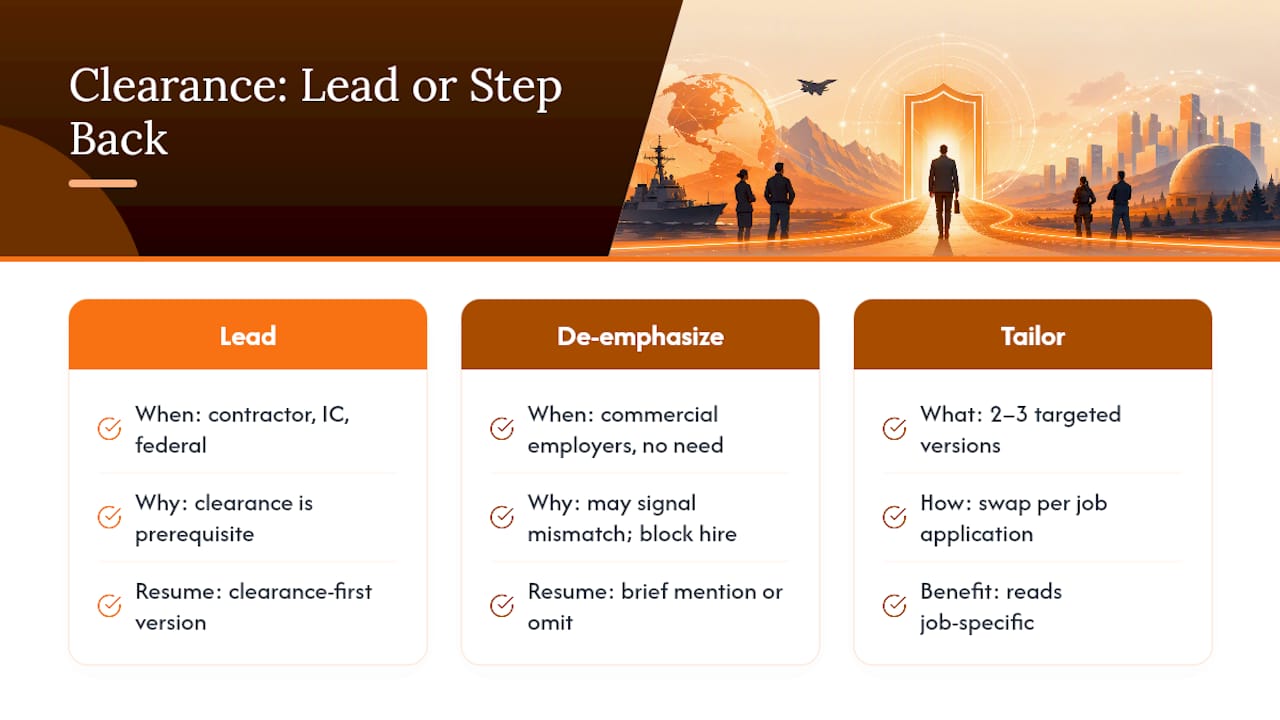
When Should Your Clearance Lead the Resume, and When Should It Step Back?
Lead with your clearance when you're applying to contractor, IC, or federal roles where the clearance is a prerequisite, not a bonus. In those cases, burying it costs you callbacks you'd otherwise get.
De-emphasize it, or leave it off entirely, when you're applying to a commercial employer with no clearance requirement, or worse, one that specifically avoids cleared candidates due to sponsorship or facility restrictions some companies quietly maintain. A clearance that isn't relevant to the role can occasionally read as a mismatch signal rather than an asset.
The fix isn't picking one version of your resume and hoping it fits every application. It's keeping two or three targeted versions, one that leads with the clearance for cleared roles, and one that mentions it briefly or not at all for commercial applications where it adds no value. Tailoring per job takes more effort upfront, but it's the difference between a resume that reads as generic and one that reads as built for the specific opening.
Get Your Cleared Resume in Front of the Right Hiring Managers
Getting the phrasing right is only half the battle. The other half is making sure the resume actually lands in front of someone who's hiring for cleared roles, instead of disappearing into a job board queue with a thousand other applicants. A specialized platform is built specifically for that gap. Rather than submitting into the same generic pipeline as every other candidate, the platform combines resume tailoring with direct connections to hiring managers actively looking for cleared IT and cybersecurity talent.
An AI job search co-pilot helps optimize your resume's phrasing and formatting so the clearance line, status, and polygraph details parse correctly across ATS platforms like the ones covered above. Combined with recruiter-vetted placements, that means less time guessing whether your resume is even reaching a human, and more time in front of hiring managers who need cleared candidates right now. If you're ready to stop sending applications into a queue and start getting introduced directly, visit the Pluck Talent job seekers page to get started.
Where This Guidance Comes From
This guide draws on federal resume guidance from the NSA, cleared-industry resume standards from ClearedJobs.net and Best Military Resume, general resume guidance from Indeed, and phrasing examples from Resume Optimizer Pro. For a look at how cybersecurity hiring managers frame the roles they're staffing for, Careerscape's cybersecurity analyst staffing page is a useful reference point.
Sources
- The Security Clearance Line on a Resume: Exact Placement, Exact Wording, Exact Format - Cleared Job Search Advice & Career Tips Blog
- Security Clearances Resume: TS/SCI, Secret — Best Military Resume
- Resume Do's and Don'ts (NSA)
- Security Clearance Resume Examples: Secret, TS/SCI, and Q Level — Resume Optimizer Pro
- How To List a Security Clearance on Your Resume in 5 Steps — Indeed
FAQ
What Should You Put for Security Clearance on a Job Application?
List the clearance level, current status (Active, Current, or Eligible), and polygraph type and date if applicable, using standard phrasing like "Active TS/SCI with CI Polygraph, adjudicated 2024" rather than vague descriptions.
What Does Security Clearance Mean on a Job Application in the USA?
It signals that a government agency has investigated and authorized you to access classified national security information at a specific level, which many contractor, IC, and federal roles require before you can even start work.
Can You Legally Say You Have a Security Clearance on Your Resume?
Yes, listing your clearance level, status, and polygraph date is unclassified information you can disclose publicly; what you must avoid is naming classified programs, compartments, or specific mission details.
How Do You Add a Clearance to Your Resume?
Place a single line under your name and contact information stating the level, status, and polygraph details, then reinforce it with a brief mention in your professional summary and in relevant job entries to show ongoing, active use.