
Most IT consulting engagements fall into nine categories: strategy and digital advisory, architecture and governance, implementation and ERP integration, data and analytics, application development and modernization, cloud and infrastructure migration, cybersecurity and risk management, managed services, and change management and adoption. Each pairs with a contract model, project-based, retainer, or staff augmentation, that determines cost, risk, and how much internal oversight you need.
Gartner defines IT consulting as professional services that help organizations assess, design, and implement technology solutions and strategies. That definition covers a wide range of work, so matching the right engagement type to your actual business trigger matters more than picking a vendor.
- Strategy/advisory: delivers a technology roadmap and investment priorities.
- Architecture/governance: delivers reference models and data governance policy.
- Implementation/ERP: delivers a configured, tested system in production.
- Data & analytics: delivers dashboards, pipelines, or MDM programs.
- App development/modernization: delivers working code and CI/CD pipelines.
- Cloud/infrastructure: delivers a migrated, cost-optimized environment.
- Cybersecurity/risk: delivers a remediation roadmap and audit readiness.
- Managed services: delivers ongoing operational coverage under SLA.
- Change management: delivers adoption metrics and training completion.
Statistic to know: industry estimates show time-and-materials contracts make up roughly 40 to 50 percent of IT consulting engagements, with full-time dedicated arrangements representing another sizable segment. That split shapes how most proposals get structured before you ever negotiate scope.
Key Takeaways
The right IT consulting engagement type depends on matching your business trigger to the correct scope, contract model, and measurable outcome before signing any statement of work.
| Point | Details |
|---|---|
| Match trigger to type | Growth, M&A, or compliance events point toward strategy or governance engagements, not implementation. |
| Contract model shapes risk | Fixed-price transfers cost risk to the vendor; T&M transfers it to you, so budget oversight accordingly. |
| Timelines vary widely | Strategy work runs weeks to months; ERP implementations can run a year or more. |
| Outcomes beat hours | Scoping around measurable KPIs improves accountability more than billing on hours worked. |
| Change management is not optional | Attach adoption planning to the original contract rather than treating it as an add-on. |
Table of Contents
- What Are IT Strategy and Digital Strategy Engagements?
- What Do Architecture and Data Governance Engagements Cover?
- How Do ERP Implementation and Systems Integration Projects Work?
- What Are Data and Analytics Consulting Engagements?
- What Do Application Development and Modernization Engagements Deliver?
- What Should You Expect From Cloud Migration Engagements?
- What Are the Main Types of Cybersecurity Consulting Engagements?
- When Does Managed Services Replace a Consulting Engagement?
- What Does Change Management and Adoption Support Include?
- Which IT Consulting Contract Model Fits Your Project?
- How Do You Choose the Right IT Consulting Engagement Model?
- Why Outcome-Based Scoping Beats Hours-Based Scoping
- A Recruiter's View on Vendor Accountability
- Sources
- FAQ
What Are IT Strategy and Digital Strategy Engagements?
Strategy engagements produce a roadmap, not code. Consultants assess your current technology stack, benchmark it against business goals, and hand you a prioritized investment plan, often paired with vendor shortlists for whatever comes next.
You hire strategy help when internal leadership lacks bandwidth or objectivity, typically around M&A due diligence, a growth-stage scaling decision, or a cloud strategy pivot. IT strategy engagements generally last a few weeks to several months, depending on complexity, while advisory work like architecture reviews or decision clinics can wrap in days to a few weeks when the deliverable is a single decision document.
Success shows up in roadmap adoption rate, budget variance against the plan, and how fast leadership moves from recommendation to funded initiative.
Pro Tip: Ask for a one-page executive summary alongside the full roadmap. If a consultant can't compress the plan to one page, the plan probably isn't focused enough to execute.
What Do Architecture and Data Governance Engagements Cover?
Architecture engagements define how systems, data, and APIs fit together before anyone builds anything. Scope typically spans enterprise architecture, data architecture, API strategy, and master data management, with governance frameworks layered on top to keep future decisions consistent.

Expect deliverables like reference architectures, data models, governance policy documents, a data catalog, and a prioritized technical debt backlog. These artifacts only matter if someone owns them after the consultants leave.
Pro Tip: Require a named internal owner for every governance policy before the engagement closes. Architecture recommendations that lack an accountable owner get shelved within a year, no matter how good they are.
Track success through data quality KPIs, faster time-to-insight for analytics teams, and a measurable drop in duplicate data sources across departments.
How Do ERP Implementation and Systems Integration Projects Work?
Implementation engagements follow a predictable phase structure, and vendors who skip phases are usually cutting corners you'll pay for later.
- Discovery — current-state assessment and requirements gathering.
- Design — solution architecture and configuration blueprints.
- Build/configure — system setup, customization, and integration development.
- Test — user acceptance testing and data validation.
- Cutover — production go-live and data migration.
- Hypercare — intensive post-launch support, typically two to six weeks.
This lifecycle mirrors the standard discovery-to-closeout structure used across implementation and project consulting. Complex ERP rollouts can run one to several years, depending on scale and legacy system complexity.
Watch for these common risks:
- Data migration complexity that balloons scope mid-project.
- Change resistance from end users who bypass new workflows.
- Third-party vendor dependencies that stall integration timelines.
Fixed-price contracts work best when requirements are locked early; time-and-materials suits projects where discovery reveals scope you couldn't have known upfront.
What Are Data and Analytics Consulting Engagements?
Data and analytics work splits into two very different speeds. Quick BI and reporting engagements build dashboards in weeks. Advanced analytics, machine learning pilots, and master data management programs run for months and touch far more of your data infrastructure.
- Deliverables: dashboards, data pipelines, feature stores, MDM implementation, and model documentation.
- KPIs: report adoption rate, data freshness against SLA, and model accuracy metrics like MAPE or ROC where applicable.
- Timelines: dashboard builds in weeks; enterprise BI platforms and MDM programs in months.
If a vendor quotes the same timeline for a single dashboard and an enterprise MDM rollout, that's a red flag worth questioning directly.
What Do Application Development and Modernization Engagements Deliver?
These engagements cover new feature development, legacy system modernization, refactoring toward cloud-native patterns, and API enablement for systems that need to talk to newer platforms.
Deliverables include working software increments, CI/CD pipelines, automated test suites, containerization artifacts, and migration runbooks for anything being retired or replaced.
Pro Tip: Choose consultant-led delivery when you need specialized skills fast or when internal teams are already at capacity; keep development in-house when the codebase requires deep institutional knowledge that outside developers can't absorb quickly.
Measure results with deployment frequency, lead time for changes, and defect rate in production after release, all standard DevOps metrics that reveal whether modernization actually improved delivery speed.
What Should You Expect From Cloud Migration Engagements?
Cloud and infrastructure engagements range from simple lift-and-shift moves to full replatforming and cloud-native re-architecture, plus hybrid networking and ongoing cost optimization work.
- Deliverables: migration plan, operational runbooks, a security and operations handoff document, and a cost governance playbook.
- Risks: cloud cost overruns from poor sizing, latency issues nobody modeled, and compliance constraints discovered too late.
- KPIs: cost per workload, cloud waste reduction, and mean time to recovery after incidents.
Require a proof-of-concept phase before committing to full migration on anything mission-critical. A two-week pilot on a non-critical workload reveals sizing and latency problems far cheaper than discovering them in production.
What Are the Main Types of Cybersecurity Consulting Engagements?
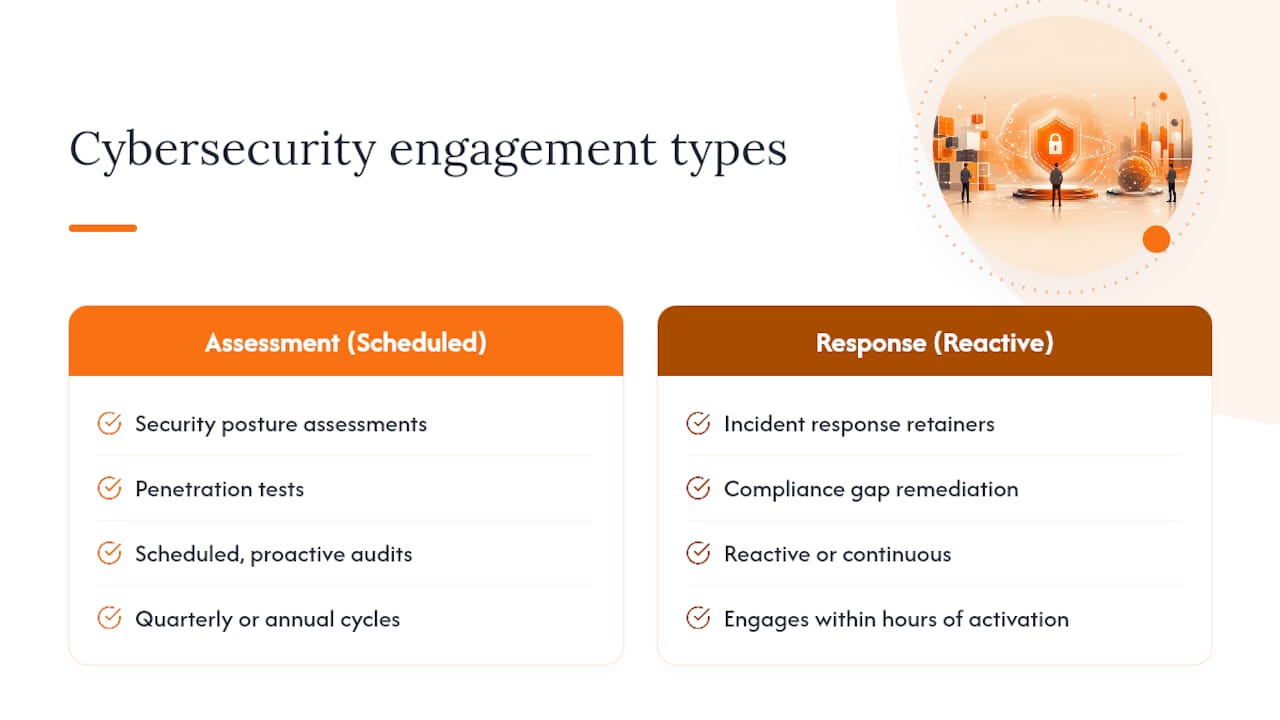
Cybersecurity engagements split into assessment work and response work, and business leaders often confuse the two. Security posture assessments and penetration tests are scheduled, proactive audits. Incident response retainers and compliance gap remediation (HIPAA, PCI, SOC 2) are reactive or continuous.
Expect risk registers, remediation roadmaps, tabletop exercise reports, and forensic reports when an incident retainer gets activated.
Pro Tip: Negotiate incident response retainer terms before you need them. Response times and hourly rates negotiated during a crisis are almost always worse than terms locked in during calm planning.
Scheduled audits typically run on quarterly or annual cycles; incident response engages within hours of activation. Track mean time to detect and respond, the percentage of critical vulnerabilities remediated, and audit pass results as your core success measures.
When Does Managed Services Replace a Consulting Engagement?
Managed services and consulting solve different problems. Consulting is bounded and ends at handoff. Managed services assume ongoing operational responsibility, with no defined end date until you cancel the contract.
- Common scopes: helpdesk tiers, infrastructure operations, managed security operations centers (SOCs), and database administration.
- Sample SLAs: uptime targets (often 99.9% or higher), incident response times, ticket resolution windows, and mean time to resolution.
- Conversion trigger: move from project consulting to managed services once a system goes live and needs continuous monitoring rather than periodic attention.
Converting post-implementation support into a managed services contract usually costs less than repeatedly rehiring the same consulting team for recurring fixes.
What Does Change Management and Adoption Support Include?
Technology rollouts fail more often from ignored change management than from broken code. These engagements cover stakeholder alignment, communications planning, role-based training, and adoption analytics that track whether people actually use what got built.
Deliverables typically include training curricula, a learning metrics dashboard, adoption playbooks, and an end-user support plan for the weeks after launch.
Pro Tip: Attach change management to the implementation contract itself rather than treating it as optional. Adoption work bolted on after go-live almost always costs more and works less well than adoption planning built into the original scope.
Track active user percentage, feature adoption rate, and the drop in support tickets after launch. A rollout with strong technical performance and weak adoption metrics is still a failed engagement.
Which IT Consulting Contract Model Fits Your Project?
Four contract models dominate IT consulting: project-based (fixed-price), time-and-materials, retainer/advisory, and staff augmentation. Hybrid structures that blend two of these are common in large enterprise programs, particularly pairing a fixed-price implementation with a T&M change order process for scope discovered mid-project.
| Model | Risk transfer | Outcome ownership | Client management load | Typical duration |
|---|---|---|---|---|
| Fixed-price project | Vendor bears cost risk | Vendor | Low once scope is locked | Weeks to over a year |
| Time-and-materials | Client bears cost risk | Shared | High, needs active oversight | Ongoing or open-ended |
| Retainer/advisory | Client pays for access | Client | Moderate | Ongoing monthly |
| Staff augmentation | Client bears delivery risk | Client | High | Weeks to months |
A vCIO or fractional CIO retainer for a mid-market company commonly runs $3,000 to $10,000 per month, depending on scope and complexity, giving you a useful benchmark when a retainer proposal lands on your desk.
The pricing trap to watch: T&M contracts without a capped budget invite scope creep, since the incentive to control hours sits with the client, not the vendor. Fixed-price contracts flip that risk but only work when requirements are genuinely stable at signing.
How Do You Choose the Right IT Consulting Engagement Model?
Six criteria decide which model fits: outcome ownership, demand predictability, internal management capacity, project duration, regulatory constraints, and budget flexibility. Walk through them in that order before you talk to a single vendor.
- Define who owns the outcome, your team or the vendor's, before drafting the SOW.
- Estimate whether demand is steady (favors retainer) or one-time (favors project-based).
- Assess your internal capacity to manage a T&M or staff augmentation arrangement.
- Set a realistic duration estimate using the timelines covered above.
- Flag regulatory requirements (HIPAA, PCI, SOC 2) that affect scope and vendor qualifications.
- Confirm budget flexibility, since fixed-price offers certainty but less room to adapt.
Ask vendors these questions during procurement:
- Who on your team owns delivery accountability day to day?
- What does the handoff process look like at engagement close?
- How do you handle scope changes discovered mid-project?
- What's your average variance between quoted and actual timeline?
- Can you share a reference from a similarly regulated client?
Watch for proposals with vague success criteria, no mention of change management, or unclear acceptance criteria for final deliverables. Those gaps almost always surface as disputes later. Reviewing how a hiring manager typically evaluates vendor accountability can sharpen your own procurement questions.
Why Outcome-Based Scoping Beats Hours-Based Scoping
Scoping engagements around measurable business outcomes—such as reduced cloud waste, faster release cycles, and more reliable reporting—improves accountability far more than scoping around hours worked. An hours-based contract rewards activity; an outcomes-based contract rewards results.
Build a simple template into every SOW: name the KPI, set the target number, and specify how you'll verify it. For example: "Reduce average cloud spend per workload by a stated percentage, verified through monthly cost reports."
Pro Tip: Consider a hybrid fee structure, a base retainer plus a bonus tied to hitting the outcome target. This aligns vendor incentives with your actual goals instead of hourly billing.
This approach works across nearly every engagement type covered above, from cybersecurity remediation to cloud migration.
A Recruiter's View on Vendor Accountability
Having watched hundreds of IT hiring cycles play out, the pattern is consistent: engagements fail less from bad technology choices and more from unclear ownership. Vendors who can't name who's accountable for what usually can't deliver what they promised either.
One action for your next vendor meeting: require a one-page outcomes matrix in the SOW before signing anything. If the vendor resists, that resistance tells you something important.
Sources
These sources informed the timelines, definitions, and engagement-model guidance throughout this article:
- Consultancy
- Technology Advisory: When and How to Engage
- IT Advisory Services: A Buyer's Guide | Wellforce
- Freelancer
If you're evaluating whether to staff a project internally or bring in outside talent, Plucktalent's job seeker platform connects IT and cybersecurity professionals with hiring managers directly, and employers building out consulting or contract teams can explore Plucktalent's placement services for vetted candidates.
FAQ
What Is the Most Common IT Consulting Engagement Type?
Time-and-materials contracts are among the most widely used, representing an estimated 40 to 50 percent of engagements, followed by full-time dedicated arrangements at roughly 25 to 30 percent.
How Long Does an IT Strategy Engagement Typically Take?
Most IT strategy engagements run a few weeks to several months, while short advisory deliverables like decision clinics can finish in days to weeks.
What's the Difference Between Consulting and Managed Services?
Consulting is bounded and ends at handoff; managed services assume ongoing operational responsibility with no fixed end date, typically governed by an SLA.
How Much Does a Fractional CIO Retainer Cost?
A vCIO or fractional CIO engagement for a mid-market company commonly runs $3,000 to $10,000 per month, depending on scope and complexity.
When Should I Choose Fixed-Price Over Time-and-Materials?
Choose fixed-price when requirements are stable and well-defined at signing; choose time-and-materials when scope is likely to evolve as discovery reveals new requirements.