
The best behavioral interview answers for IT roles lead with the outcome, follow the STAR structure, use "I" instead of "we," and quantify the result. Interviewers score you on ownership and measurable impact, not storytelling flair. The immediate next step is to prepare six to eight adaptable STAR stories mapped to the competency buckets interviewers actually test, then rehearse each one out loud until it lands in under two minutes.
TL;DR:
- Candidates should focus on delivering concise, measurable outcomes with specific numbers in each STAR story, especially for technical performance improvements.
- Preparing six to eight varied, quantifiable stories across key categories can cover most common behavioral questions efficiently without over-prepare.
- Rehearsing answers aloud within a two-minute limit enhances natural delivery and helps identify filler words or pacing issues.
- Highlighting individual ownership, clear actions, and defensible trade-offs is critical for interviewers to recognize candor and decision-making skills.
- Building a tailored, AI-optimized profile that aligns with prepared stories increases the chances of being called for interviews by hiring managers.
Table of Contents
- Behavioral Interview Answers for IT: The STAR Method and Time Budget
- Common Behavioral Questions in IT Roles With Model Answers
- How to Build a Story Bank That Covers Every Question Type
- Behavioral Interview Mistakes That Cost IT Candidates the Offer
- How to Rehearse Behavioral Answers So They Sound Natural
- What Recruiters Actually Look for in IT Behavioral Answers
- Handling Remote Work and Collaboration Questions in IT Interviews
- A Recruiter's Perspective on What Actually Wins Interviews
- How Plucktalent Helps You Prepare and Get in Front of the Right People
- Sources
- FAQ
Behavioral Interview Answers for IT: The STAR Method and Time Budget
STAR stands for Situation, Task, Action, Result, and it's the structure interviewers are trained to listen for, whether they say so or not. Career centers like Yale's Office of Career Strategy teach it as the default framework for a reason: it forces you to show cause and effect instead of just narrating events.
The mistake most IT candidates make is treating all four parts as equally important. They're not. Here's the time split that actually works for a 90 to 120 second answer:
- Situation (about 15%): One or two sentences of context. Enough to orient the interviewer, no more.
- Task (about 10%): What you were specifically responsible for, stated plainly.
- Action (about 60%): The bulk of your answer. What you personally did, decision by decision.
- Result (about 15%): The measurable outcome, stated with a number whenever possible.
MIT's Career Advising and Professional Development office recommends this same weighting, and it maps directly to how interviewers score you. They're not grading your storytelling. They're checking boxes for ownership, decision-making under constraint, and outcomes you can defend. A candidate who spends 45 seconds setting the scene and 15 seconds on what they did has the ratio backward.
Structured behavioral interviews like this one correlate with future job performance, which is exactly why interviewers lean on them instead of asking "are you a team player?" They want evidence, not adjectives.
Some interviewers use variants like SOAR (Situation, Obstacle, Action, Result) or CAR (Context, Action, Result). If you're unsure which one an interviewer prefers, default to STAR. It's the most widely recognized version, and every variant collapses into the same four beats anyway.
Common Behavioral Questions in IT Roles With Model Answers
IT interviewers pull from a fairly predictable set of themes: incidents, conflict, missed deadlines, trade-offs, and how you handle being wrong. Coursera's breakdown of common IT interview questions confirms these categories show up across cloud, security, and software engineering interviews alike. Below are the highest-value prompts, each with a compressed STAR sketch you can adapt. Start every answer with the result, then back into the actions that produced it.
- Tell me about a conflict with a coworker. Lead with the resolution: "We shipped the feature on schedule after I proposed a compromise on the caching strategy." Then describe the two to three actions you took to get there, not the argument itself.
- Describe a production incident you handled. Open with recovery time: "I brought a payment service back online in 22 minutes during a full outage." Detail your diagnostic steps and what changed afterward, like a new alerting threshold.
- Tell me about a bug you shipped to production. Own it immediately. "I introduced a null pointer exception that affected 3% of checkout sessions before I caught it in the next deploy cycle." Explain the fix and the process change that followed.
- Describe a missed deadline. Skip the excuses. State what you delivered and when, then what you'd do differently, like breaking work into smaller milestones with earlier checkpoints.
- Tell me about a trade-off you made under pressure. This tests judgment. "I chose to ship with a known performance limitation rather than delay the release by two weeks." Explain the reasoning and the follow-up plan.
- Describe mentoring a junior engineer. Quantify their growth if you can, like a reduction in code review cycles or their first solo feature launch.
- Explain a technical concept to a nontechnical stakeholder. Show the translation, not the jargon. Describe how you reframed database latency as "how long a customer waits for the page to load."
- Tell me about a time you took ownership beyond your role. This is where you show initiative without sounding like you overstepped. Describe the gap you noticed and the specific action you took to close it.
- Describe a performance or scaling improvement you led. This is the one where hard numbers matter most.
- Tell me about a time you disagreed with a technical decision. Show you can push back respectfully and defer when outvoted.
- Describe a time you learned from a failure. Interviewers want the lesson, not the apology. Name the systems change that came out of it.
- Tell me about balancing competing priorities. Show your triage logic, not just that you "worked hard."
The thread connecting every strong answer is specificity in the Action and a number in the Result. Engineering-focused interview guides recommend framing outcomes in terms interviewers in technical roles actually respect: p95 or p99 latency, mean time to resolution (MTTR), deploy frequency, or error rate reduction. "I improved things" means nothing. "I cut p99 latency from 800ms to 210ms" tells the interviewer exactly what you're capable of.
If you don't have an exact number, don't invent one.
How to Build a Story Bank That Covers Every Question Type
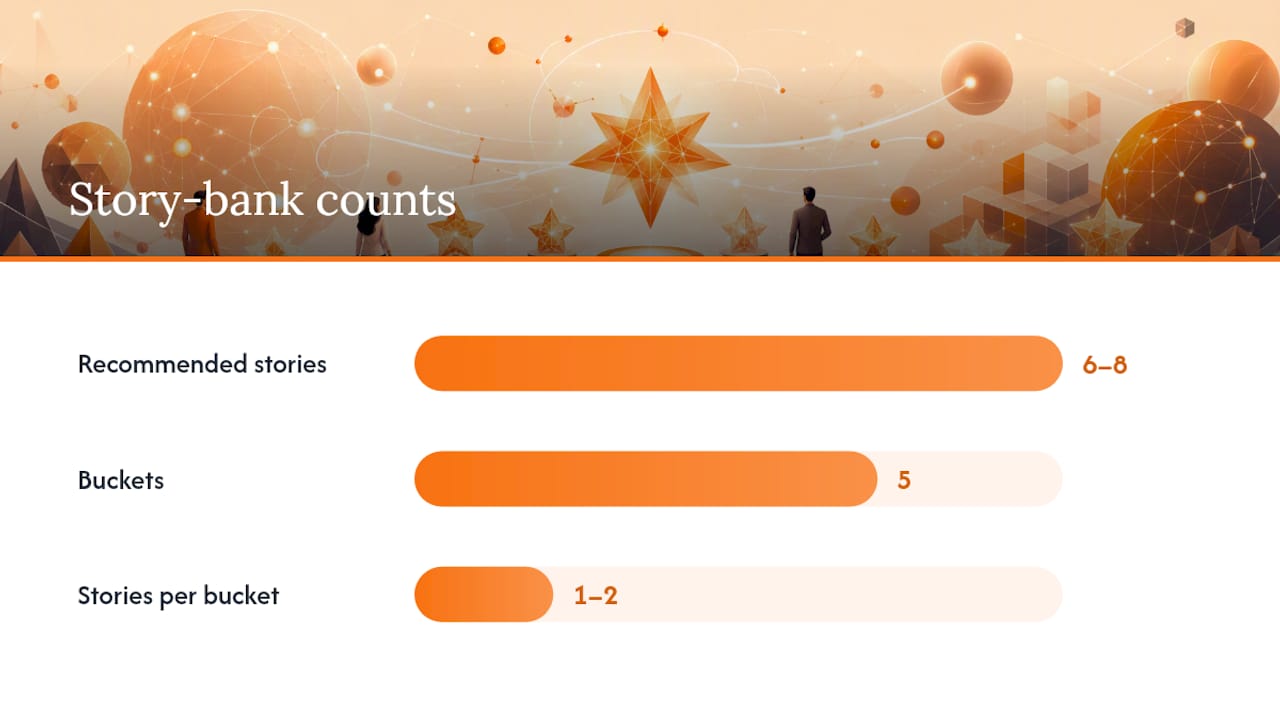
You don't need twelve different stories for twelve different questions. Most software engineers over-prepare for the technical screen and walk into the behavioral round with nothing rehearsed, which is a fixable problem. Recruiting research on engineering interviews shows that six to eight well-chosen, quantified stories typically cover the majority of behavioral prompts you'll face.
Organize your stories into five buckets:
- Conflict: A disagreement with a teammate, manager, or cross-functional partner.
- Failure: A bug, missed deadline, or bad call you made and corrected.
- Ambiguity or ownership: A project with unclear requirements where you drove clarity.
- Impact: A measurable improvement you delivered, ideally with an engineering metric attached.
- Leadership: Mentoring, influencing without authority, or leading a technical decision.
Pick one or two stories per bucket. The same incident can often serve two buckets if you shift the emphasis. Say you led an incident response for a database failover. Framed one way, it's an "impact" story about cutting downtime from 40 minutes to 8. Framed another way, it's a "leadership" story about coordinating three engineers across time zones during the outage. Same event, different lens, no memorization required.
To find your metrics, go back to the artifacts you already have: pull request descriptions, postmortem documents, sprint retros, or monitoring dashboards. A postmortem usually has the exact MTTR already written down. A PR description often states the performance delta. You're not inventing evidence, you're recovering it from work you already did.
Pro Tip: Keep a running document titled "Interview Stories" and add to it every time you close a ticket with a measurable outcome. Six months before you start job hunting, you'll already have your story bank half built.
Behavioral Interview Mistakes That Cost IT Candidates the Offer
Most weak behavioral answers fail for the same handful of reasons, and structured guides on the STAR method point to the same failure modes over and over.
- Saying "we" instead of "I." Fix: rewrite every sentence in the Action section to start with "I."
- No metric, or a vague one. Fix: pull a number from your artifacts, or estimate and label it as an estimate.
- Rambling through the Situation. Fix: cap it at two sentences before moving to Task.
- Getting defensive about failure questions. Fix: name the mistake plainly, then pivot to the process change it produced.
Here's a before and after on the same story:
Weak: "So basically our team was working on this migration project and there were a lot of moving pieces and communication was kind of an issue, but eventually we got it done."
Strong: "I led a database migration that we completed two days ahead of schedule. The team had fallen behind on communication early on, so I set up a daily 10-minute sync and a shared tracking doc, which cut our blocked-ticket time by half."
Interviewers notice three things almost immediately: whether you can separate your contribution from the team's, whether you quantify anything at all, and whether you own mistakes without spiraling into an apology tour. Miss all three and the strongest technical résumé won't save the interview.
How to Rehearse Behavioral Answers So They Sound Natural
Reading your STAR stories silently doesn't prepare you to say them under pressure. Spoken rehearsal builds a different kind of memory than reading does, and it's the gap between a smooth answer and a stammering one.
- Rehearse out loud, timed. Say each story aloud with a timer running. Target 90 to 120 seconds for your first answer to any question.
- Record and play it back. Listening to yourself surfaces filler words and pacing issues you won't catch in your head.
- Run mock interviews. Practice with a peer, a mentor, or an interview question generator that can throw prompts at you cold.
- Prepare two-line defenses for every trade-off. If your story involved choosing speed over test coverage, have a one-sentence rationale ready: "I accepted the coverage gap because the feature was time-boxed to a marketing deadline, and I flagged it for follow-up the next sprint."
Practice that mimics real follow-up questions exposes gaps that silent prep never will, particularly when a mock interviewer asks "why" a second or third time.
Pro Tip: Time your first answer specifically. If it runs past two minutes, you're including detail the interviewer didn't ask for. Cut the Situation, not the Result.
What Recruiters Actually Look for in IT Behavioral Answers
After reviewing thousands of candidate profiles, recruiting teams consistently flag the same handful of signals when they debrief with hiring managers. It's rarely about polish. It's about whether the story holds up when someone pushes on it.
- Ownership language. Does the candidate say "I decided" or hide behind "the team decided"?
- Specific actions, not summaries. "I refactored the auth service" beats "I helped improve the codebase."
- A quantifiable outcome, even an estimated one, stated with the metric named.
- A defensible trade-off. Can they explain why they chose one option over another, not just what they chose?
- Coachability. How they talk about failure often matters more than the failure itself.
One thing that consistently increases interview signal match: aligning your résumé bullets to the same STAR stories you plan to tell. If your résumé says "reduced deployment time," your interviewer will ask about it, so make sure that's one of your six to eight rehearsed stories. Guidance on building a smart job application for IT roles covers this alignment in more depth, and understanding what shapes candidate experience in IT and cybersecurity hiring explains why recruiters weight these signals the way they do.
Handling Remote Work and Collaboration Questions in IT Interviews
Remote and hybrid roles bring a specific set of behavioral questions most candidates don't prep for: how you communicate asynchronously, how you build trust with people you rarely see face to face, and how you handle a teammate who's unresponsive on a blocking issue.
These questions test a different muscle than incident or conflict stories. Interviewers want to know if you can operate without constant oversight and whether you default to over-communicating or under-communicating when working across time zones.
Build one story specifically about async collaboration. A strong example: documenting a decision in a shared doc instead of a meeting, then following up in writing when a teammate in a different time zone disagreed two days later. Show that you resolved it without needing a live call. Another useful story involves a time you flagged a blocker proactively rather than waiting for someone to ask about your progress, since silence is the most common complaint managers have about remote engineers.

If you've worked on a distributed team, mention specific tools and habits: async standups in Slack, recorded Loom walkthroughs instead of live demos, or documentation-first decision making. Vague claims like "I'm a great communicator" don't land. A concrete habit, like writing a one-paragraph context summary before every pull request, does.
A Recruiter's Perspective on What Actually Wins Interviews
The single biggest gap I see isn't a lack of accomplishments, it's a lack of rehearsal. Strong engineers walk into behavioral rounds with real stories they've simply never said out loud, and it shows in the hesitation and the missing numbers.
Three rules matter more than anything else: lead with the result, use "I" relentlessly, and quantify even when you have to estimate. Everything else, the polish, the pacing, the transitions, is secondary to those three.
If you're prepping this week, do this: pick six stories across the five buckets, write one sentence naming the result for each, then say each one out loud three times before your first interview. That's the entire system.
— Diego
How Plucktalent Helps You Prepare and Get in Front of the Right People
Building a story bank and rehearsing it solves the interview problem. It doesn't solve the problem of getting an interview in the first place, especially when your résumé is sitting in an applicant tracking system instead of a hiring manager's inbox. Plucktalent closes that gap by pairing your prepared stories with a profile built to actually reach the person making the hiring decision.
Plucky AI tailors your résumé bullets to match the same competencies your STAR stories cover, so the signal in your application matches the signal in your interview. Beyond profile optimization, Plucktalent's recruiter-vetted placement services connect you directly to hiring managers actively looking for your specific skill set, skipping the job board queue entirely. Understanding how AI-driven fit matching works shows why aligned profiles get more interviews in the first place. If you're ready to move from self-prep to a system built around getting you in front of real decision-makers, start with Plucktalent's job seeker services and see what a tailored, ATS-ready profile can do for your pipeline.
Sources
- The STAR method — CAPD (MIT)
- The Behavioral Interview — Office of Career Strategy (Yale)
- 30 Behavioral Interview Questions and Answers for Software Engineers (2026) — Greenroom
- Software Engineer Behavioral Questions (2026) — HiredKit
- Interviewprep
FAQ
What are good answers to behavioral interview questions?
A good answer follows STAR, leads with the result, uses "I" instead of "we," and closes with a quantified outcome, ideally an engineering metric like latency or MTTR for IT roles.
What is the biggest red flag to hear when being interviewed?
The biggest red flag is a candidate who can't separate their individual contribution from the team's, or who gets defensive instead of owning a mistake when asked about failure.
How do you pass a behavioral-based interview?
Prepare six to eight STAR stories mapped across conflict, failure, ownership, impact, and leadership, then rehearse each one aloud until it fits a 90 to 120 second window.
What are common IT interview questions?
Common IT behavioral questions cover production incidents, shipped bugs, missed deadlines, trade-offs under pressure, mentoring, and explaining technical concepts to nontechnical stakeholders.