
Name the role, cite one concrete result, connect it to what the team needs. Skip the passion statement.
TL;DR:
- Tailor your opening statement to include a measurable result and a signal from the job posting to immediately capture recruiter attention.
- Use specific project details and quantifiable outcomes in your proof paragraph to demonstrate relevant experience and impact.
- Research the company's engineering blog or recent announcements to customize the fit paragraph with a relevant technical or strategic connection.
- Keep your cover letter concise, under 400 words, and avoid generic openers, buzzwords, or repeating resume content to maximize readability and relevance.
- Ensure proper formatting, include your contact info in the header, and replace all technology names and metrics with actual details from your background and the job description.
Table of Contents
- What Should Go in a Cover Letter for Developers?
- Sentence-Level Tactics: What to Say and What to Cut
- Cover Letter Templates for Developers at Every Level
- Formatting Your Cover Letter So It Passes ATS Screening
- Common Cover Letter Mistakes Developers Make
- Why This Structure Works: Recruiting Experience Behind the Advice
- When a Cover Letter Actually Moves the Needle
- How Pluck Talent Helps You Skip the Guesswork
- Sources
- FAQ
What Should Go in a Cover Letter for Developers?
A cover letter for developers works in three to four short paragraphs and 250 to 400 words, according to guidance from Indeed's software developer cover letter template. Anything longer starts competing with your resume for attention, and recruiters skim these letters in under 30 seconds before deciding whether to keep reading, based on hiring behavior reported by Enhancv's developer letter examples. Each paragraph carries one job. Here's the breakdown:
- Opener (1 to 2 sentences). State the role, name one measurable result, and tie it to a signal from the job posting. This is your BLUF, and it needs to work whether the reader spends five seconds or fifty on it.
- Proof paragraph (3 to 4 sentences). Pick one project. Describe the problem, your specific action, and the outcome in numbers wherever possible. This is where "I'm a full-stack developer with five years of experience" turns into something a hiring manager can actually picture.
- Fit paragraph (2 to 3 sentences). Name something specific about the company or team. Not "I admire your mission," but a detail from their engineering blog, a technology in their stack, or a problem mentioned in the job listing itself.
- Close (1 to 2 sentences). Restate interest, point to your portfolio or GitHub, and invite next steps. No restatement of your entire resume.
Stack Overflow's guidance on developer cover letters makes a point worth repeating: lead with what you bring to the company, not with how much you want the job. Every hiring manager reads a stack of letters that open with "I am excited to apply." The ones that open with a specific number get read to the end.
Sentence-Level Tactics: What to Say and What to Cut
The gap between a forgettable cover letter and one that gets forwarded to an engineering manager usually comes down to five or six sentences. Get those right and the rest falls into place.
Openers that work:
- "I reduced our CI pipeline runtime from 22 minutes to 6 by rewriting our test parallelization, and I'd like to bring that same instinct for bottlenecks to [Team]'s deployment process."
- "After scaling a Django monolith to handle 3x traffic during a product launch, I'm looking for a team solving distributed systems problems at a similar scale."
- "Your job posting mentions migrating from a monolith to microservices. I led exactly that migration for a 12-person engineering team over eight months."
Openers to avoid:
- "I am a passionate software developer with strong communication skills." (Says nothing checkable.)
- "I have always been fascinated by technology since I was a child." (Nobody hiring a backend engineer cares about your childhood.)
- "I am writing to apply for the Software Developer position I saw on LinkedIn." (States the obvious instead of earning attention.)
To turn a resume bullet into a proof paragraph, take the bullet at face value and add the missing context. Recruiters tend to forward letters containing checkable signals: numbers, repo names, blog posts, or design docs, according to Stack Overflow's developer guide. One named artifact does more work than three vague adjectives.
Finding a team signal takes ten minutes, not ten hours, and following practical steps for aligning applications to current job-market signals can make your cover letter stand out even more. Check the company's engineering blog for a recent post about their stack or a technical challenge. Scan the job description for tools mentioned that aren't in your resume yet. Look for a recent product launch or funding announcement that explains why they're hiring right now.
Pro Tip: Search "[company name] engineering blog" before you write a single sentence of the fit paragraph. A specific reference to a real post beats generic enthusiasm every time, and it takes less effort than most people assume.
Cover Letter Templates for Developers at Every Level
Here are three annotated starting points. Each one assumes you'll swap in your own project, numbers, and target company before sending anything.
-
Entry-level template. "I'm applying for the Junior Developer role on your platform team. During my capstone project, I built a REST API serving 200 concurrent users and cut response times by 50% through query optimization. [Company]'s focus on [specific technology from posting] matches the stack I used in that project and want to keep building with. I've attached my resume and would welcome the chance to talk through how I approach debugging under pressure." Swap: project name, specific technology, and one number from your strongest school or personal project.
-
Mid-level template. "As a software engineer who redesigned our checkout flow to cut cart abandonment by 18%, I'm drawn to [Team]'s work on [specific product area mentioned in posting]. That redesign meant untangling a legacy payment integration while keeping uptime above 99.9% during the transition, which taught me how to ship changes without breaking things customers depend on. Your recent post about [specific engineering blog topic] describes a similar tradeoff, and I'd like to bring that experience to your team. I've included links to two relevant repositories below." Swap: the metric, the legacy system detail, and the specific blog reference.
-
Senior template. "I led the migration of a monolithic order-processing system to microservices for a team of 14 engineers, cutting deployment time from 45 minutes to under 5 while maintaining zero downtime. That project meant making hard calls about which services to split first and how to manage data consistency across boundaries, tradeoffs I'd bring to [Team]'s stated goal of scaling your platform for [specific context from posting]. I've managed both the technical and people side of a migration like this, and I'm looking for a senior or staff role where system design and mentorship both matter. My design docs from that migration are linked below." Swap: system scale, team size, the specific tradeoff named, and a leadership detail relevant to the target role.
Annotate your own draft the same way: replace generic tech language with the exact tool names from the posting, swap in your real numbers, and reference the team you're addressing by name wherever the template says "[Team]" or "[Company]."
Formatting Your Cover Letter So It Passes ATS Screening
Applicant tracking systems parse your letter before a human ever sees it, and formatting mistakes get files rejected before your writing gets a chance.
- Include your name, phone, email, and portfolio or GitHub link in the header, not buried mid-paragraph.
- Save the file as a text-based PDF, not a scanned image, named clearly (e.g., "JaneDoe_CoverLetter.pdf").
- Use exact technology names from the job posting: write "Kubernetes," not "container orchestration platform."
- Spell out acronyms once on first use, then use the short form: "continuous integration (CI)."
- Skip images, logos, tables, or decorative headers. ATS parsers frequently fail to read them.
- Put portfolio and GitHub links in the header and repeat them as a single line below your sign-off rather than embedding long URLs mid-paragraph, a formatting habit Indeed's guidance recommends for scannability.
Mirroring the job description means matching its exact phrasing, not just its general topic. If the posting says "distributed systems," use that phrase rather than "scalable backend architecture," even if you mean the same thing. Recruiters and parsers both reward the exact match. Reviewing how job listings frame required skills, as covered in guidance on writing IT job descriptions, helps you understand the pattern hiring managers expect to see mirrored back.
Recruiters and hiring managers often skim cover letters in under 30 seconds, per Enhancv's data on developer applications, which is exactly why your header and opening line carry more weight than anything else on the page.
Common Cover Letter Mistakes Developers Make
Most rejected cover letters fail for the same handful of reasons, and all of them are fixable in one editing pass.
- Generic openers. "I am writing to express my interest" wastes your strongest real estate on filler.
- Repeating the resume. If a sentence just restates a bullet point without new context, cut it.
- Excessive length. Past 400 words, you're testing patience, not building a case.
- Buzzword stuffing. Listing ten frameworks without a story behind any of them reads as padding, not proof.
- Unedited AI drafts. AI-assisted first drafts are fine as a starting point, but hiring managers notice generic AI phrasing quickly. A workable rule: let AI produce roughly 70% of the initial structure, then rewrite 30% with specifics only you know, your actual metrics, your actual project names, and a real detail about the company.
- Writing one for every application. If you're applying to 40 roles a week through a mass pipeline, a generic letter (or none) may serve you better than spending an hour tailoring each one. Save the tailored letter for roles you actually want.
Why This Structure Works: Recruiting Experience Behind the Advice
This structure reflects what actually gets forwarded, not just what sounds good in a guide. Pluck Talent draws on 17 years of IT and cybersecurity recruiting experience, and this advice comes from Diego, whose background covers technical hiring and resume strategy for engineering candidates. Recruiters forward letters with checkable specifics and delete ones built on adjectives. Software developer roles remain in strong demand according to the U.S. Bureau of Labor Statistics, which makes standing out in a crowded applicant pool worth the extra ten minutes of writing.
— Diego
When a Cover Letter Actually Moves the Needle
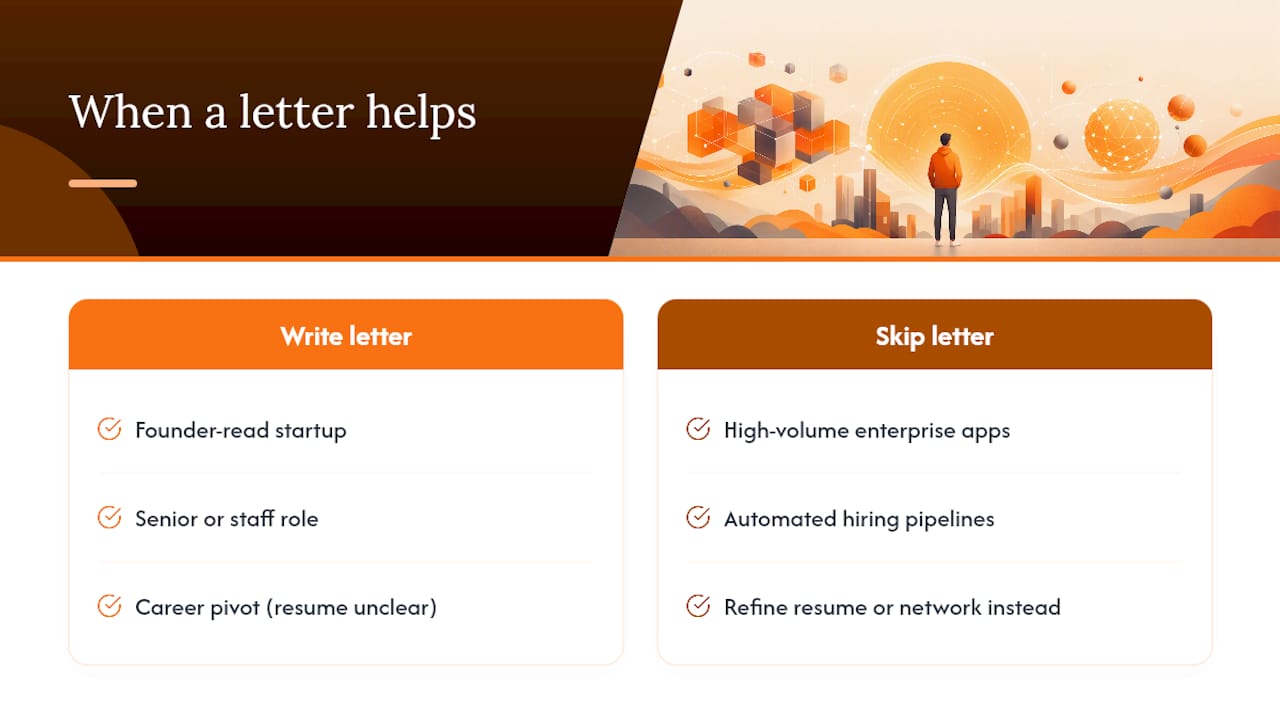
A tailored letter earns its time cost in specific situations: applying to a startup where a founder reads every application personally, going for a senior or staff role where leadership context matters, or pivoting careers where your resume alone doesn't explain the jump. In those cases, a strong letter can outweigh a slightly thinner resume.
For high-volume applications to large enterprises with automated pipelines, that same hour is often better spent refining your resume or reaching out directly to a team lead on LinkedIn. Pairing a letter with a warm introduction beats a cold submission almost every time.
How Pluck Talent Helps You Skip the Guesswork
Writing a strong cover letter still depends on knowing which role, team, and signal to write toward, and that's the part most job seekers struggle with more than the writing itself. Pluck Talent gives IT and cybersecurity professionals a faster path to that clarity: resume tailoring, direct connections to hiring managers instead of applicant-tracking black holes, and Plucky AI, a job search co-pilot that helps match your background to roles actively hiring for your specific skills.
The service pays off most when you're short on time, targeting specialized roles like cloud or security engineering, or applying into markets where competition is heavy enough that a generic application won't get opened. Instead of guessing which project to highlight or which team signal to chase, you get a tailored profile and a direct line to the people making hiring decisions. Visit the Pluck Talent job seekers page to see how resume tailoring and hiring-manager connections work together, and start with a profile review to see where your current application stands.
Sources
- Software developers, quality assurance analysts, and testers - Bureau of Labor Statistics
- Software developer cover letter example and template — Indeed
- The Developer Cover Letter — Stack Overflow Blog
- Software developer cover letter examples — Enhancv
FAQ
What are 5 common cover letter mistakes developers make?
The top five are generic openers, repeating resume bullets word for word, writing past 400 words, stuffing in buzzwords without context, and submitting unedited AI drafts that read as impersonal.
Can employers tell if you use ChatGPT for a cover letter?
Often, yes. Hiring managers notice generic AI phrasing quickly, which is why editing an AI draft to add your specific metrics, project names, and company details matters before sending it.
What does a good short cover letter for a developer look like?
A strong short letter runs 250 to 400 words across three to four paragraphs: an opener with a role and result, a proof paragraph with one project story, a fit paragraph naming something specific about the company, and a brief close pointing to your portfolio.