
Most IT contractors in the U.S. bill between $35 and $160 an hour in 2026, with the bulk of mid-to-senior technical roles landing between $60 and $110. The exact number depends heavily on role, region, and how the engagement is structured. Rates below the line are also different from what shows up on your invoice: contractor pay is what the person takes home, while the bill rate you're quoted includes payroll burden and agency margin on top. Support and help desk roles sit at the low end; AI/ML engineers, cloud architects, and cybersecurity specialists sit at the top.
TL;DR:
- Contractor pay for mid-to-senior roles will mostly range between $60 and $110 per hour in 2026, with higher rates for specialized skills like AI/ML or cybersecurity.
- Location, on-site requirements, contract urgency, and industry sector can increase rates significantly beyond the national median, especially in high-cost metros or regulated fields.
- Agency markup on W-2 contracts typically adds 35%–50%, with shorter engagements and urgent needs driving rates higher, while long-term roles may benefit from negotiated conversion clauses.
- Differentiating between invoice bill rate and contractor take-home pay is crucial, as agency margins and tax obligations inflate the quoted rate but not the contractor's actual earnings.
- Flexibility in payment structure, scope, and contract duration often results in better rates or faster hiring, especially when specific industry demands or clearance requirements apply.
Table of Contents
- Understanding IT Contractor Rates by Role and Seniority
- How Location and On-Site Work Change the Price
- What Actually Moves a Contractor's Rate
- How to Calculate Contractor Rates: Formulas and Examples
- Budgeting for Contractors: Invoice Cost vs. Take-Home Pay
- Negotiating Rates and Screening Contractors the Right Way
- What Recruiters Actually See When Rates Get Negotiated
- Why Industry Matters as Much as Role
- Where Contractor Rates Are Headed After 2026
- How Taxes Shape What Contractors Actually Charge
- What Rate Tables Miss
- How Pluck Talent Helps You Hire Contractors Without the Rate Guesswork
- Where to Verify These Numbers Yourself
- Sources
- FAQ
Understanding IT Contractor Rates by Role and Seniority
Rate tables are only useful when you know what's driving the spread inside each row. A "software developer" range that spans $50 to $110 an hour isn't sloppy data. It reflects stack, seniority, and how badly a company needs the seat filled.
Here's how the 2026 market breaks down by role:
- IT support / help desk: $35–$55/hr contractor pay, with agency bill rates typically $50–$75/hr. Rates climb when the role requires on-site presence or after-hours coverage.
- QA / test engineer: $45–$70/hr, bill rate $65–$95/hr. Automation-framework experience (Selenium, Cypress, Playwright) pushes toward the top of this band.
- General software developer: $60–$90/hr, bill rate $85–$130/hr. Full-stack generalists sit mid-range; niche frameworks or legacy-system expertise add a premium.
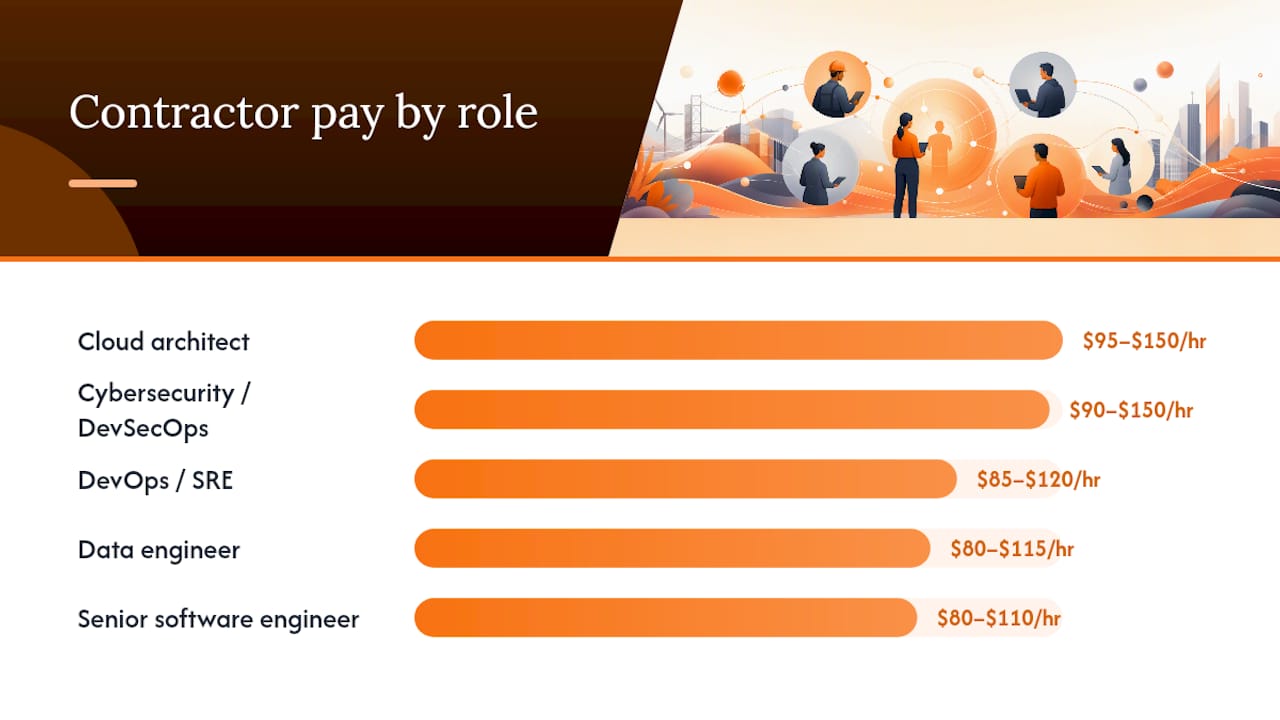
- Senior software engineer: $80–$110/hr, bill rate $115–$165/hr. This tier is where KORE1's 2026 rate data shows the widest client-to-client variance, largely tied to how urgently the role needs filling.
- DevOps / SRE: $85–$120/hr, bill rate $120–$175/hr. Kubernetes, Terraform, and multi-cloud orchestration experience are the biggest rate levers here.
- Data engineer: $80–$115/hr, bill rate $115–$165/hr. Pipeline work on Snowflake, Databricks, or dbt commands more than generic ETL experience.
- Cloud / solutions architect: $95–$150/hr, bill rate $135–$210/hr. Architects who can speak directly to leadership and own migration strategy price at the top of this range.
- Cybersecurity / DevSecOps: $90–$150/hr, bill rate $130–$210/hr. Compliance-heavy environments (see the sector breakdown below) push these numbers even higher.
- AI/ML engineer: $95–$160+/hr, bill rate $140–$225/hr. This is the tightest talent pool in the market right now, and it shows in the rate spread.
Quick stat: ZipRecruiter's September 2026 data puts the average IT contractor at roughly $113,676 a year, or about $54.65 an hour. That figure blends everything from help desk to architect, so treat it as a market anchor, not a role-specific benchmark. For a role-specific anchor, Salary puts the average closer to $131,617 a year, or roughly $63 an hour.
The common thread across every source: specialization moves the needle more than years of experience alone. A generalist with 12 years under their belt often prices below a five-year AI/ML specialist, simply because the specialist's skill set is scarcer.
How Location and On-Site Work Change the Price
National ranges serve only as starting points; location and on-site work significantly influence rates, with major metro areas generally commanding higher pay than smaller or midwest markets.
On-site requirements add their own line items. Day-rate premiums, travel reimbursement, and per diem can add $10 to $30 a day on top of the hourly rate, and local payroll tax obligations vary by state, which affects the employer's landed cost even when the contractor's quoted rate looks identical.
Take a national midpoint of $85/hr for a mid-level developer. On-site in the Bay Area, expect $105 to $120/hr plus travel costs if the contractor is relocating temporarily. The same role, fully remote and sourced from a lower-cost metro, might land at $70 to $80/hr.
Pro Tip: Ask every remote candidate where they're actually based before quoting a rate range. A remote hire in Austin and a remote hire in Manhattan will price differently even for identical scope, because their cost of living and local market anchor their expectations.
What Actually Moves a Contractor's Rate
The bill rate you see on an invoice is built from three layers: contractor pay, payroll or employer burden, and agency margin. Understanding each layer is the difference between negotiating intelligently and just accepting whatever number lands in your inbox.
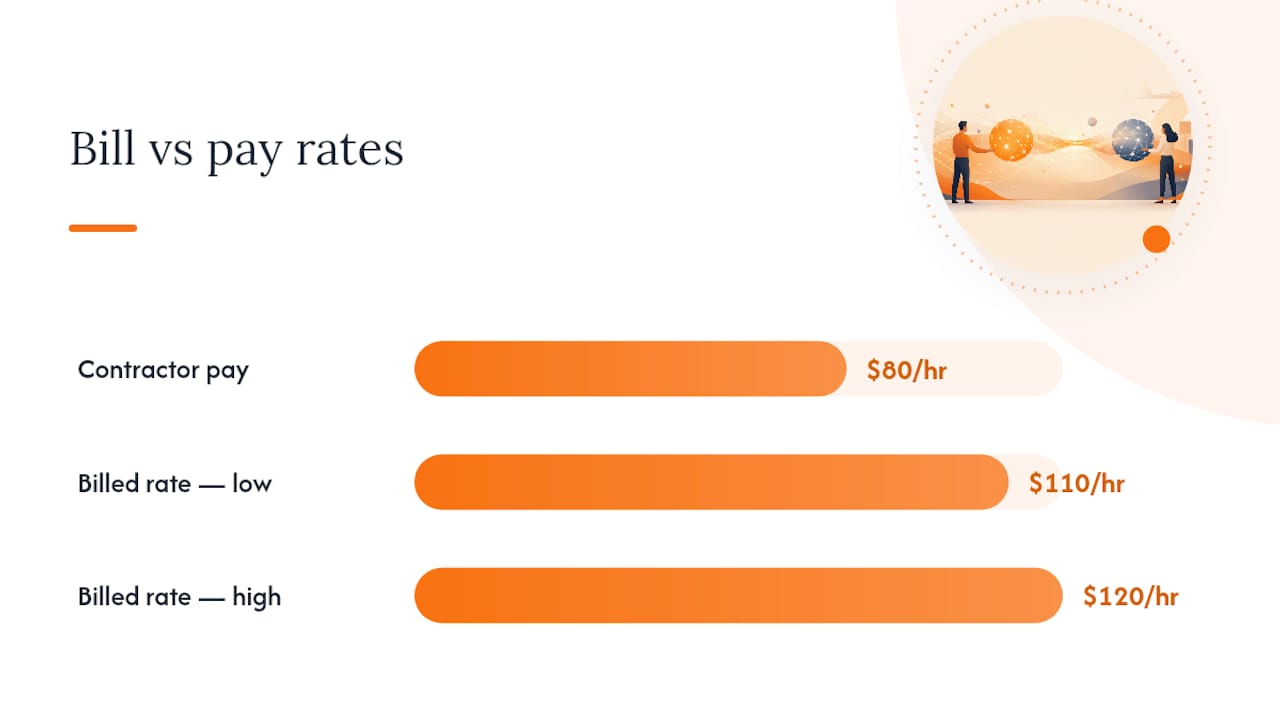
For W-2 placements, agencies typically apply a 35%–50% markup over contractor pay to cover payroll taxes, workers' compensation, benefits administration, and their own margin, according to KORE1's 2026 breakdown. A contractor earning $80/hr W-2 often bills out at $110 to $120/hr.
Corp-to-corp (C2C) arrangements shift the burden to the contractor's own business entity.
Beyond payment structure, a handful of factors reliably push rates up:
- Contract duration: short engagements often cost more per hour than long ones, since BridgeView's 2026 analysis shows contractors price in expected downtime and replacement risk on brief fills.
- Urgency: needing someone in two weeks instead of six typically adds a rush premium.
- Clearances and certifications: active security clearances, CISSP, or cloud-vendor certifications can add 10%–25% to the base rate.
- Skill rarity: the fewer people who can do the job, the less room there is to negotiate.
How to Calculate Contractor Rates: Formulas and Examples
Converting salary to hourly, and hourly to bill rate, doesn't require a finance degree. It requires a formula and a clear-eyed view of what each number actually represents.
- Salary to hourly: divide annual salary by 2,080 (the standard full-time work-year). A $150,000 salary equals roughly $72/hr as a baseline. Contractors typically price above this baseline because they're absorbing their own benefits, insurance, and paid-time-off gap that a salaried employee gets for free.
- 1099 pricing uplift: independent contractors generally need to price 25%–40% above the equivalent salary-derived hourly rate to cover self-employment tax and benefits replacement.
- Bill-rate estimation: multiply contractor pay by 1.35–1.5 for W-2 placements, or divide the bill rate by that same range to back into contractor pay. KORE1 confirms this 1.35 to 1.5 multiplier as the standard heuristic agencies use.
Here's how that plays out for two common roles:
| Role | Contractor Pay (W-2) | Estimated Bill Rate | C2C Equivalent Pay |
|---|---|---|---|
| Mid-level developer | $75/hr | $105–$113/hr | $90–$110/hr |
| Cloud architect | $120/hr | $162–$175/hr | $145–$175/hr |
To get an accurate estimate for your own budget, you need four inputs: the role's base salary-equivalent, the payment structure (W-2 or C2C), the region, and the contract urgency. Skip any one of these and your number is a guess dressed up as a quote.
Budgeting for Contractors: Invoice Cost vs. Take-Home Pay
The bill rate is your landed cost. The contractor's hourly pay is what they actually keep. Confusing the two is the single most common budgeting mistake hiring managers make when comparing contract labor to a salaried hire.
To compare fairly, convert your internal salary budget into an hourly figure using the $ ÷ 2,080 formula, then compare it against the full bill rate, not the contractor's take-home pay.
Break-even math shifts with engagement length:
- Short-term (under 6 months): contracting almost always wins on total cost, since you avoid onboarding overhead and benefits commitments for a temporary need.
- Long-term (12+ months): a direct hire often becomes cheaper once you factor in the agency's ongoing margin on every invoice.
Worked example: a 6-month DevOps contractor at $130/hr bill rate costs roughly $124,800 for the engagement (160 hours a month). Compare using your contract vs. direct-hire framework before committing either way.
Agency bill rates for contract roles, per BridgeView's 2026 estimates, most commonly land between $60 and $185/hr with a midpoint near $118/hr.
Pro Tip: If you're staffing a role you expect to extend past a year, negotiate a conversion clause upfront. Converting a contractor to full-time later usually costs less than paying agency margin indefinitely.
Negotiating Rates and Screening Contractors the Right Way
Before you negotiate anything, get clarity on six things:
- What payment structure are they quoting under, W-2, 1099, or C2C?
- When can they actually start, and is that date firm?
- What's their availability during the engagement, are they juggling other clients?
- Can they provide two verifiable references from recent similar work?
- Are they willing to work on-site, and does that change their rate?
- Do they hold any required clearance or certification, and is it current?
Negotiation works better when you adjust scope rather than push straight on price. Offering a phased start, a guaranteed minimum number of hours, or a slightly longer commitment often gets you a better rate than a flat "can you go lower" ask.
Watch for red flags: a quoted rate far below market for the stated skill level, vague answers about availability, or reluctance to name references. Any of these should slow you down before you sign.
Pro Tip: A contractor who negotiates payment structure flexibility, willing to do either W-2 or C2C, is often easier to close quickly than one rigid on terms. Flexibility on structure is frequently a better predictor of a smooth engagement than the headline rate itself.
What Recruiters Actually See When Rates Get Negotiated
Recruiters don't just read a quoted rate. They read what it signals.
A candidate's quoted rate, their flexibility on payment structure, and their willingness to accept a guaranteed minimum tend to predict how fast they'll move through a hiring pipeline more reliably than years of experience alone.
Some recruiters validate market rates by cross-referencing live requisition data against role, region, and skill scarcity before a rate gets presented. In practice, this surfaces patterns hiring managers rarely see from a single job posting:
- A rigid rate with no flexibility on structure often signals a candidate juggling multiple offers, not necessarily overpricing.
- Scope adjustments, trimming a role from full ownership to a defined deliverable, have repeatedly closed gaps between client budget and candidate expectation without either side losing.
- Duration flexibility (a 3-month trial extending to 12) frequently unlocks a lower blended rate than committing to a full year upfront.
The takeaway for hiring managers writing a brief: specify structure flexibility and duration options before you specify a target rate. It gives recruiters more room to find fit.
Why Industry Matters as Much as Role
A cloud architect at a tech startup and a cloud architect at a regional bank are pricing two different jobs, even with an identical title.
Finance and banking environments carry the heaviest rate premiums, often 10%–14% above general market averages according to Salary.com's industry differentials. Regulatory compliance (SOX, PCI-DSS), legacy system integration, and security scrutiny all add to the workload, and contractors price that in.
Healthcare runs a similar pattern for different reasons. HIPAA compliance requirements and the sensitivity of the data involved mean contractors with prior healthcare-tech experience command a premium over generalists learning the compliance landscape on the job. Security and DevSecOps roles feel this most acutely, especially where a project requires formal certification. If your engagement touches ISO 27001 compliance or similar frameworks, budget for that expertise specifically, not as an afterthought.
Tech startups, by contrast, often pay closer to national midpoints in cash but compensate with equity, faster decision cycles, and less bureaucratic overhead. Contractors willing to trade some cash rate for speed and autonomy frequently gravitate here.
The practical move: state your industry explicitly in any rate conversation. A generic "cloud architect" brief invites a generic quote. A brief specifying "healthcare, HIPAA environment" gets you a number that already reflects the real workload.
Where Contractor Rates Are Headed After 2026
Three forces are shaping the next few years of contractor pricing, and none of them point toward rates flattening out.
AI and ML specialization will keep widening the gap between generalist and specialist pay. RiseWorks' 2026 global rate analysis shows the U.S. already commands a premium over most other markets for these skills, and that gap tends to grow as demand for production-grade AI systems outpaces the supply of engineers who can build them reliably.
Remote-first sourcing will keep pressure on midwest and smaller-metro rates from both directions. Employers increasingly source developers from lower-cost U.S. regions instead of paying Bay Area premiums for remote roles, which should keep a lid on generalist developer rate growth even as specialist rates climb.
Payment-structure flexibility will likely become more standard as more contractors operate as independent businesses. Expect more candidates offering both W-2 and C2C options upfront, which should make rate comparisons cleaner for hiring managers willing to ask the right questions early.
None of this suggests a dramatic reset. It suggests a market that keeps rewarding scarcity while generalist rates stay comparatively steady.
How Taxes Shape What Contractors Actually Charge
A contractor's quoted rate isn't just about market demand. It's also a tax calculation happening quietly in the background.
That's a burden a W-2 employee never sees directly, since an employer covers half of it.
Corp-to-corp contractors face a different calculation. Operating through an LLC or S-corp can offer tax advantages, but it also means covering the full cost of health insurance, retirement contributions, and business expenses out of pocket.
For hiring managers, the practical implication is simple: don't compare a 1099 quote directly against a W-2 salary without adjusting for this gap. The contractor isn't overcharging. They're pricing in obligations your payroll department normally absorbs. Understanding this upfront makes rate conversations faster and less adversarial on both sides.
What Rate Tables Miss
Hiring managers who chase the lowest quoted rate usually pay more in the end, through slower fills, mismatched skills, or contractors who churn out mid-project. The number on the invoice matters less than whether it reflects the actual scope and urgency of the work.
The better question isn't "what's the market rate." It's "what does this specific brief actually require, and does the quote match that."
— Diego
How Pluck Talent Helps You Hire Contractors Without the Rate Guesswork
Pluck Talent is the alternative to sifting through generic job boards when you need a vetted IT or cybersecurity contractor fast. Instead of posting and waiting, employers get direct access to pre-screened candidates whose rate expectations, payment structure, and availability are already validated against current market data.
That validation work is exactly what this article walked through: knowing the difference between contractor pay and bill rate, understanding what drives a quote up or down, and reading rate flexibility as a real signal. Recruiting teams can apply similar validation processes to employer searches for DevOps hires or broader contract staffing plans across cloud, data, and security roles.
If you're ready to source contractors who've already been benchmarked against 2026 market data, visit Pluck Talent's employer solutions to start a conversation about your next hire.
Where to Verify These Numbers Yourself
For ongoing rate checks, the BLS wage release data offers the government baseline. ZipRecruiter, Salary.com, KORE1, and BridgeView all publish updated role-level breakdowns worth bookmarking for live comparisons.
Sources
- Salary: It Contractor (September, 2026) United States
- Tech Contractor Hourly Rates in 2026
- IT Staffing Cost in 2026: Rates, Fees & What Actually Drives the Price - BridgeView
- Salary
FAQ
How much do IT contractors make per hour?
Most IT contractors earn between $35 and $160 an hour depending on role and seniority, with mid-to-senior developers typically landing between $60 and $110/hr, according to KORE1's 2026 data.
What jobs pay $500,000 a year in the US?
That income level generally requires a senior leadership role (VP of Engineering, CTO), a highly specialized AI/ML architecture position at a top-tier company, or independent consulting at scale rather than a standard hourly contract rate; it sits well outside typical IT contractor pay bands.
Is $80,000 a good salary in the USA?
It depends heavily on location and role. Hourly pay varies across regions and roles, generally lower in smaller or midwest markets and higher in major metro areas like the Bay Area.