
Contextual job recommendation is the practice of ranking and surfacing job postings using real-time and historical signals, such as session intent, career trajectory, location, and employer urgency, combined with semantic understanding from embeddings, large language models, or knowledge graphs, rather than relying on keyword overlap alone. It answers a different question than a search engine does. Instead of "which postings contain these words," it asks "which postings actually fit this person, right now, given everything the system knows about them."
Three things matter immediately if you are building or evaluating one of these systems.
- Relevance improves because context resolves ambiguity that keywords cannot. A query like "remote python" means something different for a data engineer with eight years of experience than for a bootcamp graduate, and only contextual signals separate the two.
- Behavioral and profile signals outperform static resume text. Click history, session recency, and application patterns tend to carry more predictive weight than a keyword match against a job title.
- The core production trade-off is recall versus latency. Broad, semantic retrieval (via embeddings or graph traversal) finds better candidates but costs more compute than string matching, which is why nearly every real system uses a cascade architecture rather than one giant model.
Research systems like LinkedIn's Dynamic Facet Suggestion and evaluation frameworks built around metrics like NDCG give you a sense of how far the field has moved past keyword matching, and how much of that progress now runs in production rather than in papers.
Key Takeaways
Contextual job recommendation works because it replaces string matching with layered signals, profile, behavior, market, and employer context, run through embedding or graph based models tuned for both relevance and production latency.
| Point | Details |
|---|---|
| Definition | Contextual recommendation ranks jobs using real-time and historical signals plus semantic models, not keyword overlap alone. |
| Signal priority | Behavioral history and session intent typically outweigh static resume keywords for predicting relevance. |
| Modeling spectrum | Collaborative filtering, knowledge graphs, GNNs (GraphSAGE, HINSAGE), and LLM embeddings each trade recall quality against compute cost and explainability. |
| Evaluation discipline | Offline metrics like NDCG diagnose model quality; online metrics like started applications and hire rate measure real impact. |
| Production trade-off | Cascade architectures balance cheap broad recall against expensive precise ranking within tight latency budgets. |
| Privacy guardrail | High-risk behavioral signals need aggregation and data minimization, since bias and re-identification risk scale with signal specificity. |
Table of Contents
- What Is Contextual Job Recommendation in Practice?
- What Signals Define "Context" in Job Matching?
- How Do Contextual Job Recommendation Systems Actually Work?
- Which Modeling Approaches Power Contextual Recommendations?
- How Should You Evaluate a Contextual Job Recommender?
- What Does It Take to Run This in Production?
- What Problems Remain Unsolved in Job Matching?
- How Contextual Recommendation Applies to Technical Hiring
- What Actually Separates a Working System From a Demo
- Sources
- FAQ
What Is Contextual Job Recommendation in Practice?
A keyword matcher and a context-aware system handle the exact same query in visibly different ways. Take a job seeker who types "senior cloud security" into a search bar at 11 p.m. on a Tuesday, from a mobile device, having just viewed three AWS-focused listings and dismissed two Azure ones.
A keyword-based system parses that string, matches it against job titles and descriptions containing "senior," "cloud," and "security," and returns everything that scores above a similarity threshold. It has no memory of the AWS listings the person just viewed, no sense of urgency from the late hour, and no way to distinguish a Fortune 500 SOC analyst role from a two-person startup's "security lead, wears many hats" posting. Both get returned as equally relevant.
A contextual system handles the same query differently. It pulls the user's recent session (AWS-heavy, Azure-averse), cross-references their profile (12 years experience, CISSP certification, prior title "Cloud Security Architect"), checks market signals (cloud security postings in their metro area have grown month over month), and re-ranks accordingly. The Azure-heavy postings drop. Roles requiring less seniority than their trajectory suggests drop too. What surfaces first are AWS-centric, senior-level openings at companies showing active hiring urgency.
The measurable difference shows up downstream, not just in ranking quality. Indeed's GPT-powered "Invite to Apply" feature, which layers contextual, LLM-generated explanations onto matches, produced a 20% increase in started applications and a 13% lift in downstream hiring success compared to a traditional matching baseline in A/B testing. That is not a marginal ranking tweak. It is context changing whether people apply at all.
What Signals Define "Context" in Job Matching?
"Context" is a catch-all term that hides a lot of engineering decisions. In practice, it breaks down into distinct signal categories, each with different freshness requirements and different risk profiles.
- User profile signals: skills, current and past titles, years of experience, certifications, and inferred career trajectory (is this person moving up, laterally, or pivoting industries).
- Session intent signals: the literal query text, time of day, device type, and referral source, which together hint at urgency and seriousness.
- Behavioral history: clicks, dwell time, saves, applications, and dismissals, weighted more heavily the more recent they are.
- Market signals: job posting velocity in a category, employer demand trends, and seasonal hiring patterns.
- Geographic and localization signals: commute radius, remote eligibility, visa or work-authorization constraints, and regional salary norms.
- Employer-side signals: hiring urgency, easy-apply availability, headcount growth, and how quickly a company typically responds to applicants.
- External market data: salary bands, in-demand certifications, and skill adjacency (which certifications tend to co-occur with which roles).
Freshness matters more here than in most recommendation domains. A user's skill set changes slowly, but session intent changes in minutes, and employer hiring urgency can flip within a day if a role gets filled or a hiring freeze hits. A system that refreshes profile embeddings weekly but caches session context for an hour is usually fine. A system that does the reverse will feel stale to users almost immediately, even if the underlying model is sound.
Privacy considerations scale with how personal the signal is. Behavioral history and inferred trajectory carry the highest re-identification risk, since a sequence of clicks can be as identifying as a name. Common mitigations include aggregating behavioral signals into embeddings rather than storing raw event logs, applying data minimization windows (discarding session data after a set retention period), and getting explicit consent before combining external market data with a user's private profile. None of that is exotic, but skipping it is one of the more common ways these systems get built into a compliance problem later.
How Do Contextual Job Recommendation Systems Actually Work?
Almost every production system follows the same broad cascade, even when the underlying models differ wildly. The stages exist because no single model can be both cheap enough to run on millions of candidates and precise enough to rank the top ten well.
- Query understanding and rewriting: parses raw input (a search string, a resume, a profile) into structured intent, often using an LLM-based rewriter rather than brittle, task-specific named-entity recognition models.
- Dynamic facet suggestion: proposes refinements, like seniority level, remote status, or salary band, to help disambiguate a query that is too short to interpret confidently.
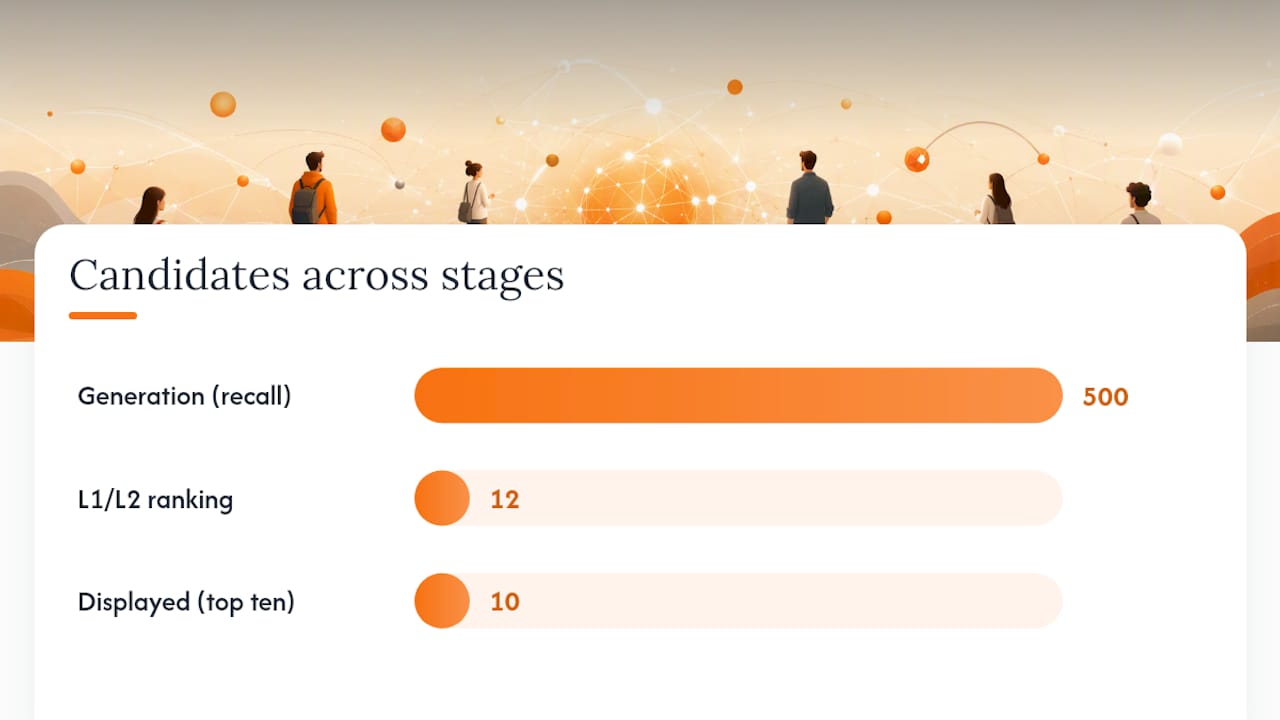
- Candidate generation (recall): retrieves a broad set of plausible matches cheaply, typically through approximate nearest neighbor (ANN) search over embeddings or graph traversal, rather than exhaustive scoring.
- L1 calibration and L2 ranking: applies progressively heavier, more expensive models to shrink the candidate set from thousands down to the dozen or so that actually get shown.
- Business-rule re-ranking: enforces constraints that pure relevance models don't handle well, such as fairness caps or sponsored placement rules.
- Explainability layer: generates a human-readable rationale for why a job appears, which increasingly runs through the same LLM used for query understanding.
- Online serving: delivers ranked results within a request-level latency budget, usually under a few hundred milliseconds end to end.
This is a recall versus precision trade-off dressed up as an architecture diagram. Recall stages are intentionally loose: they would rather return 500 mediocre candidates and miss none of the good ones than return 50 perfect candidates and risk missing one. Ranking stages then spend their compute budget narrowing that set down with far more expensive, context-heavy scoring. Industry teardowns of systems like LinkedIn's job engine describe this exact pattern: precompute job embeddings offline, compute member embeddings in real time, retrieve a narrow candidate set with ANN, then apply heavier re-ranking only to that shortlist.
Two operational concerns tend to bite teams that skip past them. Embedding indices go stale the moment a job posting is edited or closed, so index consistency needs its own monitoring, separate from model accuracy monitoring. And request-level latency budgets get eaten fast by explainability generation, since running an LLM at serving time for every result is rarely cheap enough to do for more than the top handful.
Pro Tip: Precompute job embeddings offline in batch, keep member embeddings updated in near real time, and use a small distilled language model (not your largest LLM) for facet scoring at serving time. That combination is usually what separates a system that meets its latency budget from one that doesn't.
Which Modeling Approaches Power Contextual Recommendations?
The field has moved through roughly four generations of modeling, and most production systems today blend elements of all four rather than picking one.
Collaborative filtering works from the assumption that people with similar behavior want similar jobs. It's cheap and effective when you have dense interaction data, but job search is sparse by nature. Most users interact with a handful of postings before leaving the platform, which starves collaborative filtering of the signal it needs.
Content-based filtering matches profile and job text directly, which sidesteps the sparsity problem but reintroduces the keyword-matching limitations context-aware systems exist to fix.
Hybrid approaches combine both, using collaborative signals where available and falling back to content similarity otherwise. This is the most common baseline in production, not because it's the most sophisticated, but because it degrades gracefully.
Knowledge graphs encode explicit relationships between skills, titles, certifications, and industries. A knowledge graph knows that a CISSP certification connects to security architect roles even if the words never co-occur in a resume, which makes it valuable for both recall and, notably, explainability, since a graph path is a legible reason for a recommendation.
Graph Neural Networks (GNNs and GCNs) learn representations by propagating information across that graph structure rather than relying on hand-curated edges. GraphSAGE, a widely used graph convolution approach, generates embeddings by sampling and aggregating a node's neighborhood, which lets it generalize to nodes it hasn't seen during training. HINSAGE extends this idea to heterogeneous graphs, meaning graphs with multiple node types (users, jobs, skills, companies) rather than a single uniform type, which fits the job market naturally since it is fundamentally a multi-entity network.
JobFormer, a semantic-enhanced transformer architecture, targets a specific weakness in the pipeline: the semantic gap between verbose, jargon-heavy job descriptions and sparse, inconsistently worded resumes. JobFormer-style research shows measurable gains from skill-aware recall and ranking on public benchmark datasets by parsing job descriptions more carefully before matching.
LLM-powered query understanding and query rewriters now often replace the fragmented NER pipelines that used to handle intent parsing. A unified LLM-based framework that jointly models query and contextual signals showed improved relevance in online A/B testing while reducing the system complexity of maintaining several task-specific models, and this is the piece that feeds directly into Dynamic Facet Suggestion, the mechanism LinkedIn and similar platforms use to propose query refinements when a search is too short to interpret confidently, which describes over 80% of job search queries according to SIGIR-adjacent research.
| Approach family | Recall quality | Explainability | Compute cost | Deployment ease |
|---|---|---|---|---|
| Collaborative filtering | Low on sparse data | Low | Low | High |
| Content-based / keyword | Moderate | High | Low | High |
| Knowledge graph reasoning | Moderate to high | High | Moderate | Moderate |
| GNN / graph convolution (GraphSAGE, HINSAGE) | High | Moderate | High | Low |
| Semantic transformer (JobFormer-style) | High | Moderate | High | Moderate |
| LLM embeddings + query rewriting | High | Moderate to high | High (mitigated by distillation) | Moderate |
The general pattern: the further you move toward graph and transformer methods, the better your recall on cold-start and long-tail roles, and the more compute and engineering maturity you need to run it at scale.
How Should You Evaluate a Contextual Job Recommender?
Offline metrics tell you if a model improved. Online experiments tell you if anyone cares. Both are necessary, and conflating them is one of the more common evaluation mistakes in this space.
Offline, the standard toolkit is NDCG (Normalized Discounted Cumulative Gain, which rewards ranking good results near the top), precision@k and recall@k (how many of the top k results are relevant, and how many relevant results you captured overall), and MRR (Mean Reciprocal Rank, which measures how quickly the first relevant result appears). None of these correlate perfectly with hiring outcomes on their own, which is why they function as diagnostics rather than objectives.
| Metric | Definition | Typical use |
|---|---|---|
| NDCG | Rewards relevant results ranked higher, penalized by position | Diagnostic, offline model comparison |
| Precision@k | Share of top-k results that are relevant | Diagnostic, offline tuning |
| Recall@k | Share of all relevant items captured in top-k | Diagnostic, recall-stage tuning |
| MRR | Position of the first relevant result | Diagnostic, ranking quality check |
| CTR | Click-through rate on recommended postings | Online, engagement objective |
| Started applications | Users who begin an application after viewing a match | Online, primary business objective |
| Qualified application rate | Applications that pass initial employer screening | Online, quality-adjusted objective |
| Hire rate | Applications that convert to an offer or hire | Online, ultimate outcome (slow, noisy) |
Online, CTR is fast to measure but a weak proxy for quality since users click on flashy or novel results as often as genuinely good ones. Started applications correlates better with actual relevance, and it's the metric Indeed's A/B testing used to demonstrate the 20% lift from contextual explanations. Hire rate is the outcome that matters most, but it lags weeks or months behind the recommendation event, which makes it a poor signal for iterating quickly.
A trustworthy A/B test in this domain needs a few guardrails that are easy to skip under deadline pressure: randomize at the user level, not the session level, to avoid contaminating results across a single person's multiple visits; run long enough to capture the lag between application and hire, or use started-application rate as a faster proxy; and set fairness guardrails as hard constraints, not soft targets, since a ranking model optimizing purely for engagement can quietly amplify bias against underrepresented groups.
On reproducibility, public benchmark datasets exist for offline model comparison, but they rarely capture the full richness of real production telemetry, particularly employer-side urgency signals. Most credible research in this space, including the JobFormer line of work, reports results on public datasets for comparability, then validates in production through online experiments where the real signal lives.
What Does It Take to Run This in Production?
The gap between a working prototype and a production-ready contextual recommender is almost entirely operational, not algorithmic. A few checklist items separate systems that hold up under load from ones that quietly degrade.
- Maintain nearline pipelines for embedding generation so profile and job vectors update within minutes of a change, not overnight.
- Re-shard and rebalance ANN indices on a schedule, since index skew grows silently as job postings churn.
- Blend hybrid retrieval sources (embedding similarity plus graph traversal plus keyword fallback) rather than betting the entire recall stage on one method.
- Cache aggressively at the candidate-generation layer, where results change slowly, and cache far less at the ranking layer, where personalization changes fast.
- Monitor for model degradation separately from data drift. A model can stay numerically stable while the market it describes shifts underneath it.
- Keep a rollback plan for any ranking model update, since a bad deploy in this domain doesn't just hurt engagement, it can suppress good job matches for real people mid-search.
Cost management usually comes down to one decision: what runs offline in batch versus what has to run online at request time. Job embedding generation, most of the graph computation, and bulk feature engineering belong offline. Query understanding and explainability generation have to run online, which is exactly why teams increasingly use small, distilled language models (SLMs) for those steps instead of a full-size LLM, trading a little quality for a latency budget that actually holds at scale.
Observability needs to cover feature drift, embedding drift, and fairness metrics as first-class dashboards, not afterthoughts bolted on after a bias complaint. A ranking model that starts favoring one demographic's application patterns rarely announces itself; it shows up months later as an uncomfortable pattern in outcome data if nobody was watching for it.
Pro Tip: Handle cold-start job postings (brand-new listings with no interaction history) by initializing their embeddings from graph neighbors, similar titles at similar companies, rather than waiting for click data to accumulate. Background reindexing on a rolling schedule then folds in real interaction data as it arrives, without ever showing a bare, zero-signal cold-start listing to users.
What Problems Remain Unsolved in Job Matching?
Contextual recommendation has closed the gap on keyword matching's worst failures, but several problems remain genuinely open, and they're worth understanding before you assume the technology is finished.
- Intent ambiguity persists even with LLM-based query understanding, particularly for career changers whose stated title doesn't match their actual target trajectory.
- Fairness and bias amplification is a live risk any time a model learns from historical hiring outcomes, since those outcomes encode whatever bias existed in the labor market that produced them.
- Explainability at scale is harder than it looks; a graph path or attention weight is technically an explanation, but translating it into something a job seeker actually trusts is a separate, underinvested problem.
- Cross-lingual and cross-region matching breaks down when skill taxonomies and title conventions don't map cleanly across markets.
- Long-tail job coverage suffers because niche or emerging roles simply lack the interaction volume that most models, including graph-based ones, still lean on.
The most promising near-term direction is consolidating query understanding, facet suggestion, and explainability into a single LLM-powered layer rather than maintaining separate models for each, which the CIKM research on unified query understanding already shows reduces both complexity and error propagation between stages. Knowledge-graph augmentation of embedding models is a close second, since it gives dense representations a source of structured, interpretable grounding they otherwise lack.
If you want a concrete experiment to run, try this ablation: replace your handcrafted facet extraction logic in the query-understanding stage with an LLM-based unified tagger, holding the recall and ranking stages constant, and measure the change in candidate quality and refinement engagement. It isolates exactly how much of your system's performance is coming from better query interpretation versus better ranking, which is a distinction most teams assume they understand and usually don't.
How Contextual Recommendation Applies to Technical Hiring
Apply this pipeline to IT and cybersecurity hiring specifically and the value of context becomes sharper, because these roles carry unusually dense, unusually specific signal. A certification like CISSP, a tool like Splunk, a cloud platform like AWS versus Azure, these aren't vague keywords; they're precise markers that a well-built contextual system can use far more effectively than a resume keyword scan ever could.

A realistic workflow looks like this: a candidate's query and profile pass through an LLM-based query rewriter and facet suggester, which resolves ambiguous terms ("cloud security" could mean a dozen different specializations) into structured intent. That structured intent feeds a hybrid recall stage combining embedding similarity with graph-based traversal across skills, certifications, and past employers. L1 and L2 ranking stages then narrow the candidate set using contextual signals, career trajectory, session recency, employer hiring urgency, before an explainability layer surfaces a short rationale for each match.
The KPIs worth watching in a system like this mirror the ones in the evaluation section, but weighted toward this domain's specifics: started applications on roles matching a candidate's certification stack, qualified application rate (does a hiring manager actually engage), conversion to hire, and a dismiss-to-apply ratio that flags whether the system is surfacing too many near-misses that get swiped away. Directionally, the expectation based on comparable production A/B results is fewer wasted applications and faster movement through the pipeline, not just more matches.
This is where profile tailoring and employer-side signals do real work without needing to name or compare any specific competing platform. When a candidate's resume gets tailored to surface the exact skills a hiring manager's posting emphasizes, and when recruiter-side signals about hiring urgency feed back into the ranking stage, the system stops treating "relevant" and "actionable right now" as the same thing. Plucktalent builds this logic around IT and cybersecurity roles specifically, where the signal density (certifications, specific tool stacks, security clearances) rewards exactly this kind of contextual precision far more than generic keyword search ever could. The same behavioral signals that reduce wasted time in a job search, covered in more depth in how AI reduces job search time for tech professionals, are what feed a contextual ranking model in the first place. Employer-side urgency signals, the kind that let a system prioritize a company that's actively hiring over one that posted a role six months ago and forgot to close it, work the same way whether you're reading about them in hiring-signal detection research or building them into a ranking pipeline yourself.
What Actually Separates a Working System From a Demo
Most teams that build a contextual recommendation prototype get the modeling right and the operations wrong. The gap between a notebook that scores well on NDCG and a system that survives production traffic is almost always in three places: latency budgeting, cold-start handling, and honest evaluation.
First, resist the urge to run your biggest model at serving time just because it scored best offline. A GraphSAGE or JobFormer-style model that adds 40 milliseconds too much to your ranking stage is a model you can't ship, no matter how good its offline metrics look. Distillation and cascading exist precisely because "best model" and "shippable model" are different questions, and treating them as the same one is the single most common reason prototypes stall before launch.
Second, cold start deserves more design attention than it usually gets. New roles, new candidates, and new employers all lack the interaction history that most of these models quietly assume exists. Graph-based initialization, seeding a new job's embedding from similar postings rather than waiting for clicks, is not a nice-to-have; it's the difference between a system that works for six months and one that works from day one.
Third, be honest about what your offline metrics are actually measuring. NDCG improvements on a held-out dataset feel like progress, but they don't tell you whether a job seeker applies, whether a hiring manager responds, or whether anyone gets hired. The teams that ship well tend to treat offline metrics as a gate to pass before running an online experiment, not as a finish line in themselves. If your roadmap has a model update that improved NDCG by two points but nobody has scheduled an A/B test to see if it moves started applications, that's a gap worth closing before the next sprint, not after.
Sources
- Delivering contextual job matching for millions with OpenAI | OpenAI
- Policy-Grounded Dynamic Facet Suggestions for Job Search (SIGIR ’26/related arXiv preview)
- Engineering
FAQ
What Is a Contextual Job Recommendation?
A contextual job recommendation is a job match generated by combining real-time and historical signals, like profile, behavior, and market data, with semantic models such as embeddings or knowledge graphs, rather than relying on keyword overlap alone.
How Do Contextual Job Recommendations Differ From a Job Recommendation Letter?
They're unrelated concepts that share a name. A job recommendation letter is a written endorsement from a colleague or supervisor vouching for a candidate, while contextual job recommendation is an algorithmic ranking system that surfaces relevant postings.
Does a Letter of Recommendation Increase Chances of Getting a Job?
A strong, specific letter from a credible source can strengthen an application by validating claims made in a resume, though its impact varies widely by industry and role level and it functions as one input among many in a hiring decision.
How Do I Recommend Someone for a Good Job?
Write a specific, example-driven endorsement that names concrete skills and outcomes rather than generic praise, and send it directly to the hiring manager or include it where the employer's application process requests it.
What Is the 3-Month Rule for Jobs?
Definitions vary, but the phrase commonly refers to informal guidance that a new hire should evaluate whether a role is the right fit within roughly the first three months, or that a job seeker should expect an active search to take about that long. No single authoritative standard defines it precisely.