
AI finds hiring manager contacts by extracting the job signal from a posting, mapping the company's org structure and domain, then enriching and verifying candidate contacts in real time. The three-layer enrichment pipeline typically completes this process in seconds, far faster than manual research. Real-time SMTP verification commonly achieves 95%+ deliverability accuracy, and most platforms return a small, ranked list of contacts per posting, each with a confidence score.
Key facts to know before you start:
- AI does not just match job titles. It infers reporting lines and team structure to locate the actual decision-maker.
- Confidence scores tell you how reliable each contact is. Prioritize high-confidence contacts for direct email outreach.
- For job seekers: use the ranked contact list to target the person most likely to own the hiring decision, not the most senior person at the company.
- For recruiters: pair AI-identified contacts with a quick LinkedIn scan before sending cold outreach to protect sender reputation.
Table of Contents
- How AI identifies hiring manager contacts: the three-layer pipeline
- What data sources does AI use, and how does verification work?
- How accurate is AI contact identification, and where does it fail?
- How to use AI-identified contacts once you have them
- What US privacy and outreach rules apply to discovered contacts?
- How Plucktalent applies these methods in practice
- Key Takeaways
- The gap between what AI promises and what actually matters
- Plucktalent connects IT professionals directly to verified hiring managers
- Useful sources
- FAQ
How AI identifies hiring manager contacts: the three-layer pipeline
The process converts a raw job posting into a ranked, verified contact list through three distinct layers. Each layer adds context the previous one cannot provide on its own.
Layer 1: Signal extraction. The AI reads the job posting for the role title, required skills, posting date, location, and any language that indicates reporting structure. Phrases like "reports to VP of Engineering" or "works closely with the security operations team" are parsed as org cues, not just descriptive text. These signals narrow the search before any external data source is queried.
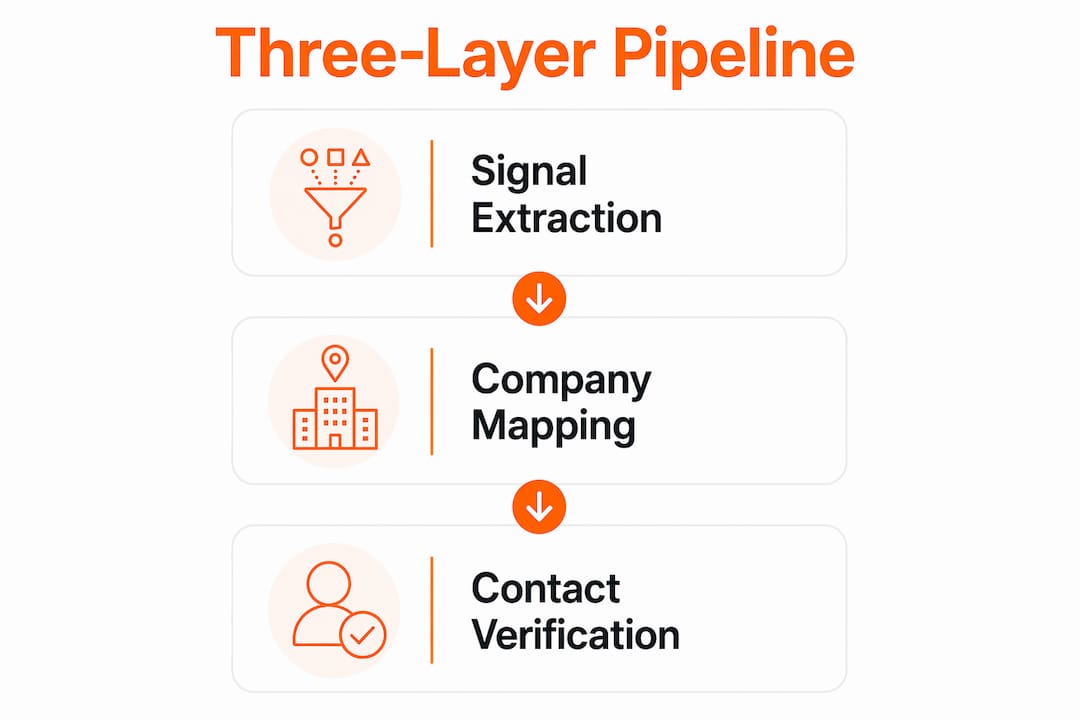
Layer 2: Company mapping. The platform resolves the employer's domain, pulls firmographic data (company size, industry, tech stack), and cross-references the LinkedIn company page to build an inferred org chart. This step identifies which department the role sits in and which seniority tier is most likely to own the hiring decision. A 50-person startup and a 5,000-person enterprise require different org reasoning to surface the right contact.

Layer 3: Contact enrichment and ranking. Employee lists are filtered by role, seniority, and department. The AI applies org reasoning, cross-references public profiles, infers email addresses from known company formats, and runs verification. The output is a ranked list of decision-makers with confidence scores, typically 2–10 contacts per posting.
Example pipeline:
- Job posting URL ingested
- Domain resolved; firmographics pulled
- LinkedIn employee filter applied by department and seniority
- Org reasoning applied (reporting cues, team patterns)
- Email addresses inferred from company format patterns
- Real-time SMTP verification run
- Contacts ranked by confidence score and returned
Pro Tip: Check whether the job posting includes a reporting-line phrase. If it does, the AI's org reasoning will be more precise, and the top-ranked contact is more likely to be the actual hiring manager rather than a generic department head.
The enrichment chain from job listing to contactable lead is well-documented in technical literature. Each crossing adds context: the posting provides the trigger, domain and firmographics narrow the account, and employee filters produce the final contact candidates.
What data sources does AI use, and how does verification work?
AI contact discovery pulls from several source categories simultaneously. No single source is sufficient on its own.
Primary sources include:
- Job boards and ATS pages: The posting itself and any structured data embedded in the career page.
- Company websites: About pages, team directories, and press releases that name employees by role.
- LinkedIn: Employee lists filtered by department, title, and seniority. Tools like LinkedIn data exporters can automate extraction of employee lists for further filtering.
- Public records and technographic databases: Funding announcements, conference speaker lists, and technology-stack data that confirm company size and structure.
- Third-party contact indexes: Aggregated databases that store previously verified email addresses and phone numbers.
Live lookups differ from cached databases in a meaningful way. Cached databases may be weeks or months old. Platforms that refresh frequently from ATS and career pages reduce stale contact risk compared with quarterly database syncs. Real-time queries against live sources, combined with SMTP verification, return verified contacts with high deliverability claims in under two minutes.
When a direct email address is not indexed, the AI infers it from the company's known format, such as first.last@domain.com or f.last@domain.com. These inferred addresses carry confidence levels (high, medium, or low) and are treated as fallbacks rather than primary results.
95%+ deliverability accuracy is the commonly cited benchmark for real-time SMTP verification, which checks whether a mail server will accept a message at the moment of request rather than relying on a stored record.
Deduplication runs across all sources to prevent the same contact from appearing under multiple name variants or email formats. AI contact discovery at scale combines org intelligence, role-based filtering, and deduplication to surface prioritized decision-makers from a target-account list.
How accurate is AI contact identification, and where does it fail?
Vendor accuracy claims are generally high, but real-world performance depends on several variables. Org changes, private domains, and contractor roles are the most common sources of error.
Common failure modes:
- Title-match false positives: A "Security Manager" title might belong to a physical security manager, not an IT security hiring manager. Simple title matching without org reasoning produces these errors regularly. Experts note that AI must infer reporting lines and team structure to identify the true hiring manager.
- Merged or split organizations: Post-acquisition org charts are often inconsistent across public sources. A contact listed as a hiring manager at the acquired company may now report to a different structure entirely.
- Contractor vs. employee confusion: Contractors often appear in LinkedIn employee lists and can be misidentified as internal hiring managers.
- Private or custom domains: Smaller companies sometimes use email formats that do not match any known pattern, making inference unreliable.
Confidence scores address some of these risks. A high-confidence contact has been verified across multiple sources with a confirmed email format. A medium-confidence contact has a likely email inferred from a pattern but not directly verified. A low-confidence contact should be treated as a starting point for manual research, not a send-ready address.
For direct hiring manager contact in IT and cybersecurity roles specifically, org reasoning matters more than in other fields because security teams often have non-standard reporting structures. The CISO may own hiring for some roles while a VP of Engineering owns others at the same company.
Pro Tip: Before sending to any medium- or low-confidence contact, run a quick LinkedIn search for the person's current employer and title. A 30-second check can prevent a bounce that damages your sender score.
How to use AI-identified contacts once you have them
The ranked contact list is a starting point, not a finished outreach queue. The confidence score determines the next action.
Confidence score thresholds and actions:
- High confidence: Send direct email. The address has been verified in real time and cross-referenced across sources.
- Medium confidence: Verify manually before emailing. Run an SMTP check, confirm the person's current role on LinkedIn, and check for mutual connections.
- Low confidence: Use LinkedIn first. Send a connection request or InMail before attempting email. Treat the email address as unconfirmed.
Verification checklist before outreach:
- Confirm the contact's current employer and title on LinkedIn.
- Check the company's email format against at least two known employee addresses.
- Run a quick SMTP check using a free tool if the platform has not already done so.
- Look for mutual connections who can provide a warm introduction.
- Confirm the job posting is still active before sending.
Personalization should be tied to the job signal, not generic. Reference the specific role, a skill gap the posting reveals, or a recent company announcement. Subject lines that name the role and department outperform generic "I saw your job posting" openers. For practical messaging tactics, getting a response from hiring managers requires specificity at the subject-line level.
Outreach sequencing matters for deliverability. For uncertain addresses, start with LinkedIn. For high-confidence contacts, email is appropriate as a first touch. Follow-ups should be spaced at least three to five business days apart. Sending multiple messages in rapid succession to unverified addresses is one of the fastest ways to trigger spam filters.
Pro Tip: AI tools for tech job seekers can extract structured contact files, including name, inferred email, and LinkedIn URL, from a job listing URL in minutes. Use these outputs as a verification checklist, not a send list.
What US privacy and outreach rules apply to discovered contacts?
Cold outreach to hiring managers in the United States is legal under current law, but specific rules apply.
CAN-SPAM Act requirements for cold email:
- Include a valid physical postal address in every commercial email.
- Use accurate "From," "To," and "Reply-To" headers. Deceptive subject lines are prohibited.
- Provide a clear, functioning opt-out mechanism in every message.
- Honor opt-out requests within 10 business days.
- Identify the message clearly as an advertisement if it is promotional in nature.
CCPA considerations for California-based contacts:
- The California Consumer Privacy Act gives California residents the right to know what personal data is held about them and to request deletion.
- Using publicly available data (LinkedIn profiles, company websites) for outreach is generally lower-risk than purchasing bulk contact lists.
- Retain only the data needed for the outreach campaign. Delete contact records that are no longer active or relevant.
- If a contact requests data deletion, comply promptly and document the action.
Sender reputation best practices:
- Warm up new sending domains gradually. Do not send hundreds of cold emails from a new address on day one.
- Monitor bounce rates. A bounce rate above 2% signals a list quality problem that will damage deliverability over time.
- Use a dedicated sending domain for cold outreach, separate from your primary business domain.
- Keep a suppression list of opt-outs and hard bounces and apply it before every send.
Outreach to hiring managers is not subject to TCPA rules unless it involves phone calls or text messages. For email, CAN-SPAM is the governing federal framework. State laws like CCPA add data-handling obligations on top of that baseline.
How Plucktalent applies these methods in practice
Plucktalent combines 17 years of IT and cybersecurity recruiting experience with Plucky AI, a job search co-pilot that operationalizes the three-layer pipeline described above.
Key implementation details:
- Verified contact workflows: Plucky AI applies real-time verification and confidence scoring to hiring manager contacts surfaced from active job postings, not cached databases.
- ATS and job-post integrations: The platform reads live job postings to extract signal data, then maps company structure and enriches contacts using the same enrichment chain covered in this article.
- Deduplication and ranking: Contacts are deduplicated across sources and ranked by confidence score before they reach the user.
- IT and cybersecurity focus: Diego, Plucktalent's recruiting lead with 17 years of hands-on experience placing IT and cybersecurity professionals, has worked directly with the hiring managers these tools surface. That domain knowledge informs how org reasoning is calibrated for security-specific reporting structures.
The platform is designed for IT and cybersecurity professionals who want to move past generic job board applications and reach the people who actually own hiring decisions. Verified contacts, ATS-ready profiles, and outreach guidance are built into a single workflow.
Pro Tip: The AI hiring signals Plucky AI detects go beyond the job posting itself. Active hiring signals, such as recent funding, headcount growth, and new contract awards, indicate companies likely to have open roles that have not yet been posted publicly.
Key Takeaways
AI identifies hiring manager contacts through a three-layer pipeline: signal extraction, company mapping, and real-time contact enrichment with SMTP verification achieving 95%+ deliverability accuracy.
| Point | Details |
|---|---|
| Three-layer pipeline | AI runs signal extraction, company mapping, and contact enrichment in sequence to produce ranked contacts. |
| SMTP verification accuracy | Real-time SMTP checks commonly achieve 95%+ deliverability accuracy, reducing bounce risk significantly. |
| Confidence score thresholds | High-confidence contacts are send-ready; medium requires manual verification; low confidence means start with LinkedIn. |
| Title matching alone fails | AI must apply org reasoning to infer reporting lines, not just match job titles, to find the true hiring manager. |
| Plucktalent implementation | Plucky AI applies the full three-layer pipeline with live verification and confidence scoring for IT and cybersecurity roles. |
The gap between what AI promises and what actually matters
There is a tendency to treat AI-identified contacts as a finished product. They are not. The pipeline is reliable for narrowing a large company to a short list of likely decision-makers. It is less reliable for confirming that a specific person is actively involved in a specific hire at the moment you reach out.
The most common mistake is acting on a high-confidence email address without checking whether the role is still open or whether the contact has changed positions in the last 90 days. LinkedIn tenure data is public. A 30-second check prevents a message that lands in the inbox of someone who left the company two months ago.
The second mistake is over-indexing on seniority. The AI's org reasoning surfaces the most likely hiring manager, which is often a director or senior manager, not the VP or CISO. Reaching out to the most senior person available feels logical but frequently produces no response because that person delegated the hire. Trust the confidence ranking over the title.
AI contact discovery is most valuable when it is paired with a human judgment layer: verify the current role, confirm the posting is live, and personalize the message to the specific job signal. That combination is what separates a response from a bounce.
Plucktalent connects IT professionals directly to verified hiring managers
Plucktalent is built for IT and cybersecurity professionals who want direct access to the hiring managers behind active roles, not a generic job board queue. Plucky AI applies the three-layer enrichment pipeline to live job postings, returns verified hiring manager contacts with confidence scores, and pairs those contacts with ATS-ready profile optimization and outreach guidance.
The platform handles signal extraction, company mapping, and real-time SMTP verification in a single workflow. Contacts are ranked before they reach you, so outreach starts with the highest-probability decision-makers first. For IT professionals who want to stop sending applications into a black hole and start reaching the people who own hiring decisions, the Pluck Talent job seekers page outlines subscription options and how Plucky AI works in practice.
Useful sources
The following sources provide additional technical detail on the methods covered in this article.
- Email verification accuracy and deliverability (BillionVerify): Technical explanation of how SMTP verification works and what accuracy benchmarks mean in practice.
- Email verification scoring (Emailable): Documentation on how confidence levels are assigned to inferred and verified email addresses.
- From job listing to qualified contact: the enrichment chain (Rodz): Step-by-step walkthrough of the signal-to-contact enrichment pipeline.
- Contact discovery AI (Abmatic): Overview of how org intelligence, role filtering, and deduplication combine in contact discovery at scale.
- Hiring manager API (Hirebase): Details on real-time ATS-derived contact data and how frequent refreshes reduce stale contact risk.
- AI recruiter extractor skill (Coding180): Practical guide to extracting structured contact data from job listing URLs using automation.
- Find recommended contacts (GTM AI): Documentation on AI-ranked contact recommendations personalized to CRM win patterns and engagement history.
- Pluck Talent job seekers page: Overview of Plucky AI features, verified contact workflows, and subscription options for IT and cybersecurity professionals.
FAQ
How does AI find hiring manager contacts from a job posting?
AI extracts the job signal from the posting, maps the company's domain and org structure, then enriches and verifies contacts through real-time SMTP checks. The three-layer pipeline typically completes in seconds and returns 2–10 ranked contacts per posting.
Why does title matching alone fail to identify the right hiring manager?
Simple title matching surfaces the wrong person when reporting structures are non-standard or when a title applies to multiple departments. AI must apply org reasoning, parsing reporting cues and team patterns, to locate the actual decision-maker rather than the most senior person with a related title.
Do hiring managers care if you use AI to find their contact information?
Most hiring managers do not object to being contacted through AI-identified outreach, provided the message is relevant and compliant with CAN-SPAM. Personalization tied to the specific role and a clear opt-out mechanism are the two factors that determine whether outreach is received professionally.
What is a confidence score in AI contact discovery?
A confidence score indicates how reliably an AI platform has verified a contact's identity and email address. High-confidence contacts have been verified across multiple sources with confirmed email formats; low-confidence contacts have inferred addresses that require manual verification before outreach.
How does Plucktalent verify hiring manager contacts?
Plucky AI applies real-time SMTP verification and confidence scoring to contacts surfaced from live job postings, not cached databases. Contacts are ranked before delivery so outreach starts with the highest-probability decision-makers in IT and cybersecurity roles.